The Mongol Storm at Bukhara
The sack of a Transoxianan city, 1220 CE
617 AH / 1220 CE
 Educational historical reconstruction
Where
Bukhara, in Transoxiana (modern Uzbekistan)
39.7747, 64.4286 · View on OpenStreetMap
Background
In 1219 Chinggis Khan turned the full force of the Mongol armies upon the Khwarazmian empire, the great Muslim state that then ruled Transoxiana, Khurasan and much of the eastern Islamic world, after its governor at Utrar had killed a Mongol trade caravan and the Khwarazm-Shah had refused redress. In the campaign that followed, from 1219 to 1221, the rich and ancient cities of the land between the two rivers fell one after another, and the destruction was on a scale the Muslim world had not known. Bukhara, one of the wealthiest and most learned cities of Islam, a centre of scholarship, trade and the crafts on the Silk Road, was among the first to fall, early in 1220 (617 AH): the army appeared before the walls, the garrison was broken, the citadel held out for some days and was then stormed, and the city was given over to plunder and largely burned, its people killed, enslaved or driven out. The near-contemporary Sunni historian Ibn al-Athir, in al-Kamil fi al-Tarikh, recoiled from the task of describing the Mongol catastrophe, calling it the greatest calamity to befall mankind since God created Adam; the Persian historian Juvayni, in his Tarikh-i Jahangushay, written a generation later while he served the Mongols and could see what they had wrought, preserved the famous report that Chinggis Khan rode to the great congregational mosque, mounted its pulpit, and declared himself the punishment of God sent upon the people for their sins, before the city was put to the sack. The jurist al-Juzjani, in his Tabaqat-i Nasiri, carried the same horror eastward to the Muslims of India. Samarqand, Nishapur and the other cities of Transoxiana and Khurasan met similar fates, and the eastern Muslim world took generations to recover, even as it would in time absorb and convert the conquerors. This scene depicts the sack as it happens: the great mudbrick citadel, the Ark, still standing as the last redoubt, a tall brick minaret of the kind that marked the congregational mosque beside it, black smoke pouring from the burning city, the townspeople fleeing with what they can carry past the collapsed bazaar, and a column of Mongol horsemen advancing across the oasis plain under their standards. In keeping with a sober treatment of such a subject no killing and no bodies are shown; the fire, the flight and the closing cavalry carry the weight of the catastrophe.
What you see
A great mudbrick citadel with sloping ramparts, round corner bastions and a tall arched gatehouse fills the middle of the scene: this is the Ark, the ancient fortress-palace at the heart of a Central Asian oasis city, the last redoubt of its defenders.
A single slender baked-brick minaret rises beside the citadel, banded with decorative brickwork and tapering to a lantern-top. It is the kind of tall round tower that marked the great congregational mosques of Transoxiana, a landmark that often outlasted the city around it.
Thick black smoke pours up from behind the walls and rolls across the sky: the city is burning. This is not a quiet ruin but a sack in progress, the moment of the catastrophe itself rather than its aftermath.
Townspeople flee across the open ground in front of the gate, snatching up bundles, loading a handcart with what little they can carry, the bazaar stalls beside them collapsed and the brick and timber of the market scattered underfoot.
On the right a long column of mounted warriors advances across the dusty plain under tall standards, raising a haze as they come. These are the riders of the steppe army closing on the city, the horse-archers whose mobility overwhelmed the settled lands.
The flat, irrigated oasis country runs away to the horizon: the land between the two great rivers, Transoxiana, where Bukhara and Samarqand had been among the wealthiest and most learned cities of the Muslim world.
This is Bukhara in 1220, falling to the army of Chinggis Khan in the war he loosed on the Khwarazmian empire. By the report he mounted the pulpit of the great mosque and called himself the punishment of God; the eastern Muslim world took generations to recover from the blow.
Primary sources
Ibn al-Athir, al-Kamil fi al-Tarikh (early 13th c.): The near-contemporary Sunni history; the Mongol invasion of the Khwarazmian empire and the destruction of its cities, which he laments as the greatest calamity to befall mankind since the creation of Adam.
Further reading & cross-references
Ata-Malik Juvayni, Tarikh-i Jahangushay (13th c.): The Persian history of the Mongol conquests; the fall of Bukhara and the report of Chinggis Khan on the pulpit of the great mosque. Written under Mongol service, used with that awareness.
al-Juzjani, Tabaqat-i Nasiri (13th c.): The Sunni historian who fled the invasion eastward to the Delhi Sultanate; carries the horror of the Mongol storm to the Muslims of India and corroborates the scale of the destruction in Transoxiana.
Modern histories of the Mongol conquests (academic): Used for the chronology of the Khwarazmian war, the sequence of the storming of the citadel, and the assessment of the scale of the destruction. Non-confessional cross-reference.
The Kalyan minaret and the Ark of Bukhara (extant fabric): Material cross-reference. The great brick minaret of 1127 survived the sack and still stands; the Ark citadel mound is the ancient fortress-core of the city. Supports the standing landmarks shown, with the caveat that the surrounding Poi-Kalyan mosque and madrasa ensemble is 16th-c. and later and must not appear in a 1220 scene.
Questions & answers
- Where is The Mongol Storm at Bukhara?
- Bukhara, in Transoxiana (modern Uzbekistan)
- When did it happen?
- 617 AH / 1220 CE
- What is the story of The Mongol Storm at Bukhara?
- In 1219 Chinggis Khan turned the full force of the Mongol armies upon the Khwarazmian empire, the great Muslim state that then ruled Transoxiana, Khurasan and much of the eastern Islamic world, after its governor at Utrar had killed a Mongol trade caravan and the Khwarazm-Shah had refused redress.…
Related places
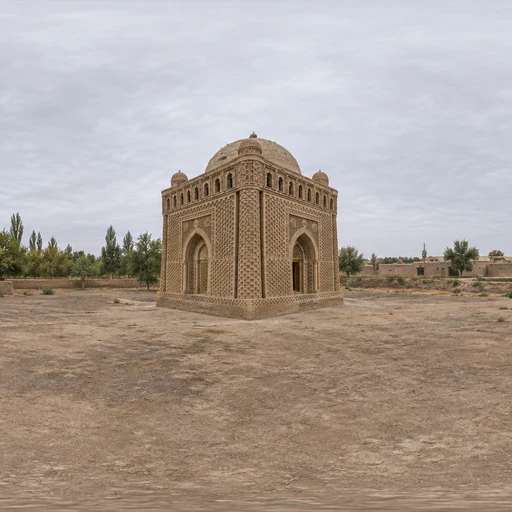
The Samanid Mausoleum at Bukhara
c. 300 AH / c. 914 CE

The Minaret of Jam
c. 590 AH / 1190s CE

After the Mongol Storm at Nishapur
618 AH / 1221 CE

Ghazni and the Road to India
417 AH / c. 1026 CE

Mahmud of Ghazna's Indian Campaigns
Ghaznavid campaigns (388-421 AH / 998-1030 CE)

The Fortress of Alamut
483 AH / 1090 CE
Guess places like this in GeoSiyer
Drop into a 360° scene from Islamic history and pin where, and when, it happened.
Play GeoSiyer