The First Ottoman Printing Press
Müteferrika prints in Istanbul, 1729 CE
1141 AH / 1729 CE
 Educational historical reconstruction
Where
Istanbul, by the Bosphorus
41.0080, 28.9780 · View on OpenStreetMap
Background
Printing with movable type had long been known in the Ottoman lands among the Jewish, Armenian and Greek communities, who printed in their own scripts, but books in Arabic script, the script of the Qur'an and of Turkish and Arabic and Persian learning, had continued to be made by the pens of scribes, both out of reverence for the written word and from the interest of the great guild of copyists. In 1726 Ibrahim Muteferrika, a man of Hungarian origin who had entered Ottoman service and risen as a scholar and official, together with Said Efendi, obtained from the sultan Ahmed III and the grand vizier, and with a legal opinion from the chief jurist permitting the printing of books other than the Qur'an and the core religious texts, the licence to establish a printing house for Arabic-script books at Istanbul. The press printed its first book, a great Arabic-Turkish dictionary (the Vankulu Lugati), in 1729, and over the following years issued a series of works of history, geography, language and science, handsomely printed and sometimes illustrated with maps, including Muteferrika's own treatise urging military and political reform. The enterprise printed only seventeen titles before it faltered, and printing in Arabic script did not become general in the empire until much later; but it was a landmark, the beginning of the printed book in the Islamic Ottoman world, and a sign of the cautious openness of the age. This scene depicts Muteferrika's press and workshop at Istanbul, with the wooden press, the cases of Arabic type and the first printed sheets. In keeping with the project's ethics any figure is anonymous and at a distance.
What you see
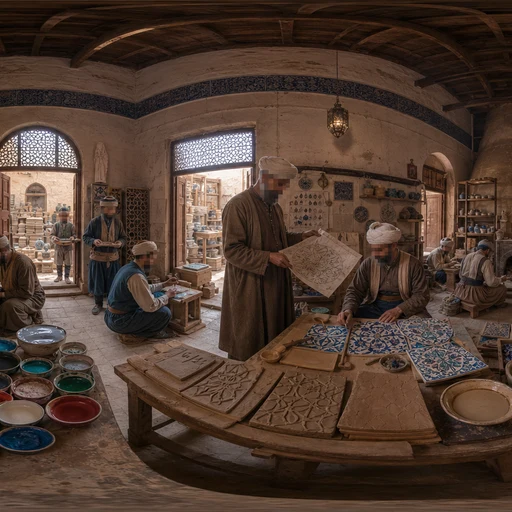
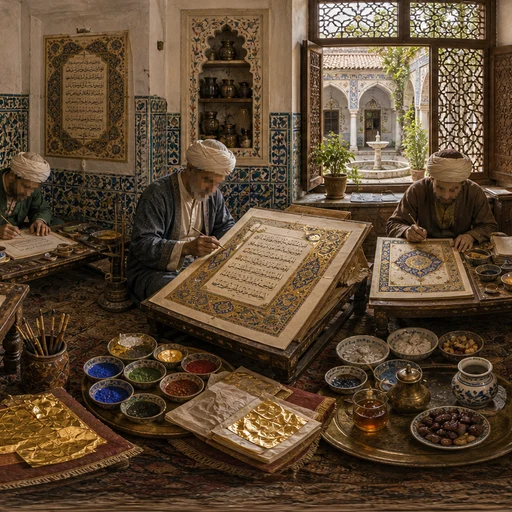
A printing press of wood and iron stands in a workshop, its great screw and bed ready; beside it trays of movable Arabic type, the sorts arranged in their cases, and inking pads and fresh sheets hung up to dry.
The first printed sheets bear a fine naskh Arabic script set in metal type, not the hand of a scribe; a printed book in the Turkish tongue of a kind never before made in the empire.
This is the press of Ibrahim Muteferrika, who with official permission and the blessing of the scholars set up the first printing house for books in Arabic script in the Ottoman lands, and printed its first book in 1729.
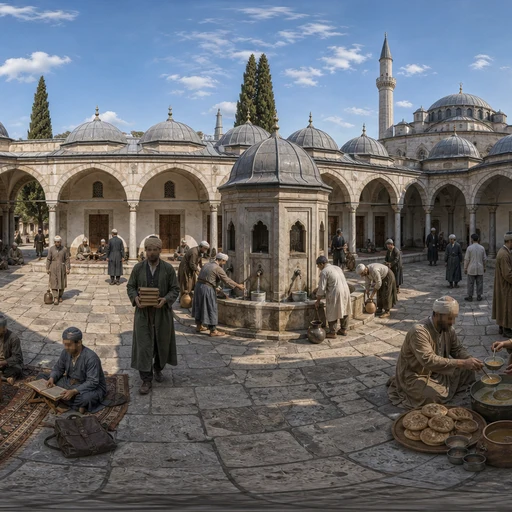
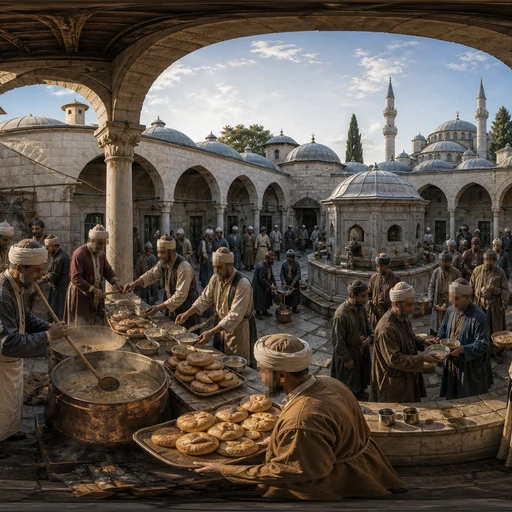
The setting is the imperial capital in the age the Ottomans later called the Tulip period, a time of new openness to the arts and to the learning of the world, with its mansions, gardens and libraries.
The city of domes and minarets stretches along a strait between two continents, the seat of the sultan and the centre of the empire.
Ibrahim Muteferrika and the first Ottoman Arabic-type press are recorded in the history of printing. The scene depicts the press and the workshop; no individual is shown by likeness.
Further reading & cross-references
The Muteferrika imprints (1729 onward) and their colophons: The primary objects. Used for the press, the first book and the works printed. Confidence high.
The fatwa and imperial licence for the press (1726-27): Used for the permission, its conditions (excluding the Qur'an and core religious texts) and the scholars' role. Confidence high.
Histories of Ottoman printing and the Tulip period: Used for the context, Muteferrika's life and the limits and significance of the enterprise. Confidence high.
An 18th-century Istanbul workshop (material context): The hand-press and type of the period constrain the depiction; the specific workshop is representative.
Questions & answers
- Where is The First Ottoman Printing Press?
- Istanbul, by the Bosphorus
- When did it happen?
- 1141 AH / 1729 CE
- What is the story of The First Ottoman Printing Press?
- Printing with movable type had long been known in the Ottoman lands among the Jewish, Armenian and Greek communities, who printed in their own scripts, but books in Arabic script, the script of the Qur'an and of Turkish and Arabic and Persian learning, had continued to be made by the pens of…
Guess places like this in GeoSiyer
Drop into a 360° scene from Islamic history and pin where, and when, it happened.
Play GeoSiyer