The First Collection of the Qur'an
Zayd ibn Thabit (RA) gathers the suhuf under Abu Bakr, Madinah, 12 AH
12 AH / 633 CE
 Educational historical reconstruction
Where
Madinah, near the Prophet's mosque
24.4672, 39.6112 · View on OpenStreetMap
Background
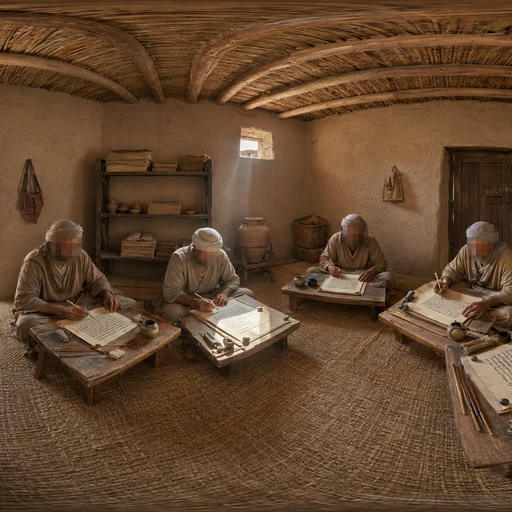
In the twelfth year after the Hijra (633 CE), in the caliphate of Abu Bakr al-Siddiq (radiyallahu 'anhu), the Qur'an was for the first time gathered into a single authoritative written collection. The narrative is preserved in detail in Sahih al-Bukhari (Kitab Fada'il al-Qur'an) on the authority of Zayd ibn Thabit (RA) himself: after the battle of Yamama against Musaylima, in which a large number of the qurra', those who had memorised the Qur'an, were killed, 'Umar ibn al-Khattab (RA) came to Abu Bakr (RA) fearing that further loss of the reciters would mean the loss of part of the text, and urged that it be collected. Abu Bakr (RA) hesitated to do what the Prophet (peace and blessings be upon him) had not done, then was satisfied that it was a good and necessary undertaking, and charged Zayd ibn Thabit (RA), a young Ansari who had been one of the scribes of the revelation, with the task. Zayd (RA), who described the work as harder to him than moving a mountain, gathered the Qur'an "from palm-leaf stalks, thin white stones, and the breasts of men," requiring written attestation alongside memorisation. The result was not yet a bound codex (mushaf) but a set of ordered sheets (suhuf), which were kept by Abu Bakr (RA) until his death, then by 'Umar (RA), and after him by his daughter Hafsa bint 'Umar (RA). This collection became the reference base from which, about two decades later under 'Uthman ibn 'Affan (RA), the standardised copies were prepared and dispatched to the garrison cities. This scene depicts the working chamber of the first collection, the diverse substrates of the early revelation being copied onto uniform sheets, the writing materials as protagonist, the finished suhuf set apart under guard. It is the first of the two great moments in the history of the written Qur'an, the second being the 'Uthmanic standardisation.
What you see
A plain Madinian chamber of mud-brick walls and a flat roof of palm-trunk beams over a packed-earth floor, no glazed tile, no carved stone, no columned hall. This is the modest building stock of the Hijazi oasis in the first generation after the Hijra, not a later Damascene or Iraqi institution.
The room's protagonists are the writing materials, not figures: pieces of tanned leather (adim), parchment strips (riqaq), bleached papyrus, thin flat stones (likhaf), shoulder-blade bones (aktaf) and the broad bases of palm-leaf ribs ('usub), the very substrates on which the revelation had been written down piecemeal in the Prophet's lifetime, now being gathered onto uniform sheets.
Reed pens, horn inkwells, and dishes of soot-and-gum ink lie at a low writing-board where loose fragments are being copied out onto fresh leaves and squared up into ordered sheets (suhuf). A plain wooden chest stands ready to receive and keep them.
The Arabic on the leaves is the early Hijazi hand: angular, without the dots that distinguish letters of shared skeleton, without short-vowel marks, end-of-verse rosettes, chapter headings, or any illumination. There is no bound codex here, only flat, stacked sheets, because this stage produced suhuf, not yet a sewn mushaf.
Two written copies of any passage are being required before it is entered, the method the sources ascribe to the collector, who accepted what was both memorised and attested in writing. Men come and go bringing their written fragments to be checked against the memorisers' recitation.
Set a little apart and guarded is the finished stack of sheets, the single authoritative suhuf that, the tradition records, was kept by Abu Bakr (RA), then by 'Umar (RA), and after him by his daughter Hafsa (RA), to become two decades later the base text for the standardised mushaf.
Through a high window the crowns of date palms and a corner of the low mosque wall place the room in the oasis-city of the Prophet (peace and blessings be upon him), Madinah, the Rashidun capital, in the months following the battle of Yamama in the twelfth year after the Hijra.
Primary sources
Sahih al-Bukhari, Kitab Fada'il al-Qur'an (9th c.): The foundational account, narrated by Zayd ibn Thabit (RA): 'Umar's (RA) alarm after Yamama, Abu Bakr's (RA) commission, the method of collection from written fragments and the memorisers, and the keeping of the suhuf by Abu Bakr, then 'Umar, then Hafsa (RA). The primary text-critical anchor.
Jalal al-Din al-Suyuti, al-Itqan fi 'Ulum al-Qur'an (15th c.): The classical synthesis of the Qur'anic sciences. Used for the conventional sequence (piecemeal writing under the Prophet, the Abu Bakr collection, the 'Uthmanic standardisation) and the names of the early writing substrates.
Ibn Kathir, Fada'il al-Qur'an / al-Bidaya wa al-Nihaya (14th c.): Sunni synthesis. Confirms the dating to the aftermath of Yamama in 12 AH and the role of Zayd ibn Thabit (RA) under Abu Bakr (RA).
Further reading & cross-references
Ibn Abi Dawud, Kitab al-Masahif (10th c.): The detailed early monograph on the compilation. Distinguishes the Abu Bakr-era suhuf from the later 'Uthmanic masahif, names the materials, and preserves the transmission of the sheets to Hafsa (RA).
François Déroche, La transmission écrite du Coran dans les débuts de l'islam (Brill, 2009): Standard modern paleographic study. Used for the appearance of the early Hijazi script, undotted, unvocalised, angular, and for the material reality of writing on parchment, papyrus, leather, bone, and palm-leaf ribs in the first decades.
Surviving early Hijazi codices, Birmingham, Paris (BnF Arabe 328), Sana'a (extant): Material evidence for the script, layout, and substrates of the earliest written Qur'an, constraining the reconstruction of the leaves and the hand depicted. Note these are codex folios of the standardisation era; the 12 AH suhuf themselves do not survive.
Questions & answers
- Where is The First Collection of the Qur'an?
- Madinah, near the Prophet's mosque
- When did it happen?
- 12 AH / 633 CE
- What is the story of The First Collection of the Qur'an?
- In the twelfth year after the Hijra (633 CE), in the caliphate of Abu Bakr al-Siddiq (radiyallahu 'anhu), the Qur'an was for the first time gathered into a single authoritative written collection. The narrative is preserved in detail in Sahih al-Bukhari (Kitab Fada'il al-Qur'an) on the authority of…
Related places
The Standardization of the Mushaf
c. 30 AH / c. 650 CE

The Saqifa of Banu Sa'idah
11 AH / 632 CE

Umar's Diwan and the Hijri Calendar
c. 17 AH / 638 CE

Ibn al-Zubayr Rebuilds the Kaaba
64 AH / 683 CE

After the Qarmatian Raid on Makkah
Dhul Hijja 317 AH / 930 CE

The Arbitration at Dumat al-Jandal
Ramadan 37 AH / February 658 CE
Guess places like this in GeoSiyer
Drop into a 360° scene from Islamic history and pin where, and when, it happened.
Play GeoSiyer