Saladin's Army Enters Jerusalem
Morning of 2 October 1187, 27 Rajab 583 AH
583 AH / 1187 CE
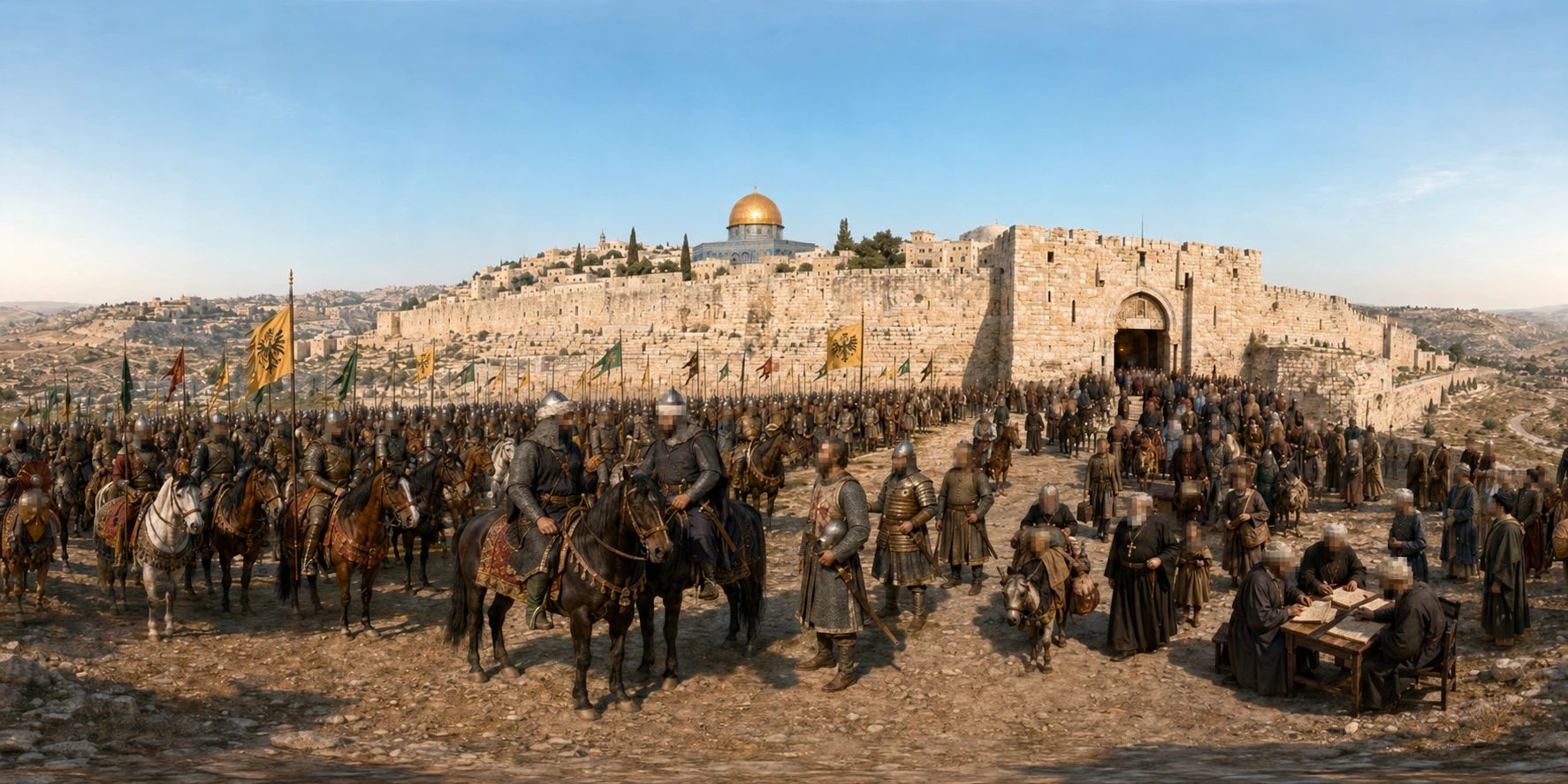 Educational historical reconstruction
Where
Bab al-Khalil (Jaffa Gate), Jerusalem
31.7766, 35.2275 · View on OpenStreetMap
Background
On Friday 2 October 1187, corresponding to 27 Rajab 583 AH, the army of Salah al-Din Yusuf ibn Ayyub (Saladin) entered Jerusalem after a negotiated surrender by the Crusader defense under Balian of Ibelin. The city had been under Latin Christian rule for 88 years since the First Crusade's capture in 1099. After Saladin's decisive victory at the Battle of Hattin in early July 1187, almost the entire Kingdom of Jerusalem had collapsed; the city was besieged from late September and terms were agreed on 2 October. Unlike the 1099 conquest, the Ayyubid entry was largely without massacre: Frankish residents were permitted to leave on payment of a per-head ransom, and a substantial number too poor to pay were freed by Saladin's brother al-Adil and others. The Dome of the Rock and al-Aqsa were ritually re-consecrated as mosques, the great gilt cross atop the Dome of the Rock was taken down, Christian altars and screens were removed from al-Aqsa, and the building was cleaned with rosewater. The first Friday sermon in al-Aqsa under restored Muslim rule was delivered the following week, on 9 October 1187, by the qadi Muhyi al-Din ibn al-Zaki. The date of entry being 27 Rajab, the traditional date of the Prophet Muhammad's (peace and blessings be upon him) Night Journey to Jerusalem, was widely noted as deliberate by Ayyubid chroniclers. This scene depicts the gatehouse area on the morning of the entry, before the formal procession to the Haram esplanade.
What you see
Walled city built on a limestone ridge with valleys falling away to the east and west, the broad Hinnom and Kidron depressions place this on the Judean plateau rather than the Levantine coast or the Hijaz.
Tall ashlar curtain walls and a heavy stone gatehouse with a sharply pointed Crusader-era arch. The fabric is twelfth-century Crusader and earlier Fatimid masonry, not the smooth limestone of the much later Ottoman walls that frame the Old City today.
Beyond the gate, the silhouette of a tall keep with battered talus base, the Tower of David citadel as the Crusaders left it, before its Ayyubid and Mamluk reworking.
Above the rooftops to the east, the octagonal drum and shallow domed roof of the Dome of the Rock rise over the Haram esplanade. The dome is dark and lead-covered, not the gilded gold that Sultan Sulayman would add in the sixteenth century. A workman on a wooden scaffold is removing a large gilt cross fixed to the apex.
Yellow banners with black Arabic calligraphy ripple over a column of mailed cavalry, Ayyubid colors, often associated with the Banu Ayyub. The lances carry pennants, not the Latin tau crosses of the previous defenders.
Riders wear conical iron helmets with mail aventails, segmented lamellar coats, and composite bows in saddle cases, Seljuq-Ayyubid equipment, not the heater shields and great helms of contemporary Frankish knights.
A long, orderly file of Latin Christian civilians under armed escort moves out through a side gate carrying packs and small chests, the ransomed citizens being permitted to leave under the surrender terms, not the indiscriminate massacre that had accompanied the Crusader capture of the same city eighty-eight years earlier.
A crescent moon is being raised over the gatehouse where a tau cross had hung; the cross itself is being lowered onto a pile of dismantled Latin signage in the gateway. The day is being treated ceremonially, it is 27 Rajab, the night the Prophet Muhammad (peace and blessings be upon him) is traditionally said to have been taken on the Night Journey from this very rock, and the timing of the entry is not accidental.
Primary sources
Ibn al-Athir, al-Kamil fi al-Tarikh (early 13th c.): Zengid-affiliated chronicler from Mosul; more critical of Saladin's leniency on ransom than his court sources. Useful as a counterweight; supports the broad event sequence.
Further reading & cross-references
Imad al-Din al-Isfahani, al-Fath al-Qussi fi al-Fath al-Qudsi (late 12th c.): Saladin's chancery secretary; eyewitness or near-eyewitness. The most detailed primary account of the negotiation, the entry, and the re-Islamization of the Haram. Florid rhymed-prose style but factually careful on dates and named participants.
Baha al-Din ibn Shaddad, al-Nawadir al-Sultaniyya (early 13th c.): Personal biographer of Saladin who joined the court after the entry into Jerusalem. Supports the negotiated-surrender framing and the deliberate timing on 27 Rajab.
Anne-Marie Eddé, Saladin (English trans. Harvard, 2011): Standard modern academic biography in English. Used for the dating of the surrender negotiations, the ransom mechanics, and the careful re-Islamization sequence over the following weeks.
Carole Hillenbrand, The Crusades: Islamic Perspectives (Edinburgh, 1999): Used for the comparative framing against the 1099 capture, the symbolic weight of 27 Rajab, and the wider Islamic historiographical tradition of the entry as a moral counterpoint to the First Crusade.
Standing fabric of the Old City of Jerusalem (extant): Used to constrain which architecture is twelfth-century and which is later. Critically: the present yellow-stone Ottoman walls (Sulayman, 1535-1542) post-date this scene by 350 years and must NOT be the wall depicted. The pre-Ottoman Crusader and earlier fabric is the correct reference, including the Crusader-period Tower of David before its Ayyubid and Mamluk reworking, and the dark lead dome on the Dome of the Rock before its sixteenth-century gilding.
Questions & answers
- Where is Saladin's Army Enters Jerusalem?
- Bab al-Khalil (Jaffa Gate), Jerusalem
- When did it happen?
- 583 AH / 1187 CE
- What is the story of Saladin's Army Enters Jerusalem?
- On Friday 2 October 1187, corresponding to 27 Rajab 583 AH, the army of Salah al-Din Yusuf ibn Ayyub (Saladin) entered Jerusalem after a negotiated surrender by the Crusader defense under Balian of Ibelin. The city had been under Latin Christian rule for 88 years since the First Crusade's capture…
Related places


Guess places like this in GeoSiyer
Drop into a 360° scene from Islamic history and pin where, and when, it happened.
Play GeoSiyer