The Sankore Mosque and Scholars of Timbuktu
A centre of learning at the desert's edge, c. 1500
c. 905 AH / 1500 CE
 Educational historical reconstruction
Where
Sankore Mosque, Timbuktu
16.7766, -2.9998 · View on OpenStreetMap
Background
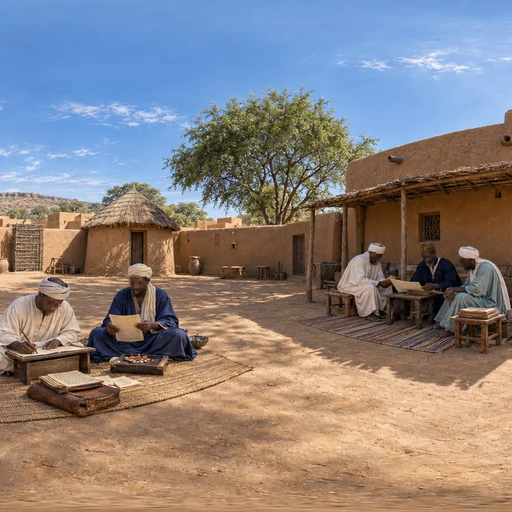
Around 1500 (905 AH) Timbuktu, near the northern bend of the Niger where the desert meets the Sahel, stood at its height as a centre of trade and Islamic learning under the Songhai Empire of Askia Muhammad (rahimahu Allah), the pious ruler who made the pilgrimage to Makkah and fostered the scholars of his realm. The town was a great terminus of the trans-Saharan caravan trade in gold, salt and other goods, and books were among its most valued commodities, copied, traded and gathered into large private libraries. Its religious and scholarly life centred on three great mosques, Djinguereber, Sankore and Sidi Yahya, of which Sankore was especially associated with teaching. The so-called University of Sankore was not a single college in the European sense but a dense network of independent scholars, each gathering students in teaching circles around the mosque and in their own houses, covering Qur'an and its recitation, hadith, jurisprudence of the Maliki school, Arabic grammar, logic, astronomy and medicine. Families of scholars such as the Aqit clan, from whom the later jurist Ahmad Baba al-Timbukti (rahimahu Allah) descended, gave the town an unbroken learned tradition, and its manuscripts, many of which survive, are a witness to the depth of West African Islamic scholarship. The mosques are built in the Sudano-Sahelian earthen tradition, of mud brick and mud plaster, with stepped pyramidal minarets studded with toron beams. This learned and prosperous age was broken in 1591 when a Moroccan Saadi army crossed the desert, defeated Songhai and sacked Timbuktu, deporting many of its scholars. This scene depicts the Sankore mosque and its scholars at the height of the town's learning, around 1500, with the book-sellers and a caravan in view.
What you see
A town of earthen houses stands where the open sands of a great desert give way to dry savannah, near the northern bend of a great river. This is a caravan terminus between the Sahara and the Sahel, the meeting point of desert and river trade.
The mosque is built of sun-dried earth in the Sudano-Sahelian manner, mud brick under a smooth mud render, and its minaret is a tapering stepped pyramid studded all over with the projecting ends of wooden toron beams, not a round or square tower with a dome.
In the shade of the walls and courtyard, scholars sit in teaching circles with students around them, each holding a wooden writing-board or a loose-leaf manuscript. This is a place of instruction as much as of prayer.
Traders at stalls offer bound and loose manuscripts for sale, and copyists bend over sheets with reed pens. Books here are a prized and costly commodity, copied and traded as well as studied.
A camel caravan is loading or arriving at the edge of the town, the animals laden with slabs of rock salt and bales of goods. The wealth of the town rests on the trans-Saharan trade in gold, salt and books.
The mosque stands as the heart of a famous gathering of teachers and students, a network of independent scholars and Qur'an schools rather than a single college building, the learning for which the town was renowned across the Muslim world.
Further reading & cross-references
Al-Sa'di, Tarikh al-Sudan (17th c., Timbuktu): The major Sunni West African chronicle, by a Timbuktu scholar. The source for the mosques of Timbuktu, the families of scholars, the patronage of the Songhai rulers and the learning of the town. Confidence high for the scholarly life, written within living memory of the late peak.
Ahmad Baba al-Timbukti, Nayl al-Ibtihaj bi-Tatriz al-Dibaj (c. 1600): The biographical dictionary of Maliki scholars by the most famous jurist of Timbuktu, himself of the Aqit family. Witness from within to the scholarly network and to the books and learning of the town.
Tarikh al-Fattash (attributed to Mahmud Kati and others, 16th-17th c.): Second Niger-bend chronicle; supports the picture of trade and learning under Songhai. Transmission debated, used cautiously.
John O. Hunwick, Timbuktu and the Songhay Empire (Brill, 1999): Modern translation and study of the Tarikh al-Sudan with full apparatus. Used for the chronology of Songhai, Askia Muhammad's patronage, and the structure of Timbuktu's learning. Confidence high.
Elias N. Saad, Social History of Timbuktu: The Role of Muslim Scholars and Notables 1400-1900 (Cambridge, 1983): Standard social history of the scholarly families and institutions. Used for the nature of the Sankore network and the manuscript culture.
Standing mosques of Timbuktu (extant) and the surviving Timbuktu manuscripts: The earthen mosques (much rebuilt over time) and the surviving manuscript collections constrain the architecture and the book culture. The standing fabric has been repaired and rebuilt repeatedly, so the c. 1500 form is reconstructed from the tradition.
Questions & answers
- Where is The Sankore Mosque and Scholars of Timbuktu?
- Sankore Mosque, Timbuktu
- When did it happen?
- c. 905 AH / 1500 CE
- What is the story of The Sankore Mosque and Scholars of Timbuktu?
- Around 1500 (905 AH) Timbuktu, near the northern bend of the Niger where the desert meets the Sahel, stood at its height as a centre of trade and Islamic learning under the Songhai Empire of Askia Muhammad (rahimahu Allah), the pious ruler who made the pilgrimage to Makkah and fostered the scholars…
Related places



Guess places like this in GeoSiyer
Drop into a 360° scene from Islamic history and pin where, and when, it happened.
Play GeoSiyer