The Saqifa of Banu Sa'idah
The first pledge of allegiance to Abu Bakr (RA), Madinah, 11 AH
11 AH / 632 CE
 Educational historical reconstruction
Where
Saqifat Bani Sa'idah, the Khazraj quarter of Madinah
24.4686, 39.6109 · View on OpenStreetMap
Background
On the day the Messenger of Allah (peace and blessings be upon him) passed away in Madinah, 12 Rabi' al-Awwal in the eleventh year after the Hijra, conventionally 8 June 632 CE, the Ansar gathered in the saqifa (the roofed portico) of the Banu Sa'idah, a clan of the Khazraj, to deliberate on who should lead the community after him. Word reached Abu Bakr al-Siddiq, 'Umar ibn al-Khattab, and Abu 'Ubayda ibn al-Jarrah (radiyallahu 'anhum), who came to the gathering. The principal account is preserved in Sahih al-Bukhari in the long narration of 'Umar (RA) himself (in Kitab al-Hudud / al-Muharibin), supplemented by al-Tabari, Ibn Sa'd's Tabaqat, and Ibn Kathir's al-Bidaya wa al-Nihaya. According to these reports, a speaker of the Ansar proposed that leadership be shared, "an amir from us and an amir from you", while Abu Bakr (RA) argued that the Arabs would recognise authority only in the Quraysh, the Prophet's own people, and praised the Ansar as the helpers and supporters who would be the ministers of the affair. The discussion was tense but resolved without bloodshed: 'Umar (RA) declared that he would not be put before Abu Bakr (RA), took his hand and pledged allegiance to him, and the assembled Ansar and Muhajirun followed. The general, public pledge (bay'at al-'amma) was given the next morning in the Prophet's mosque, where the whole community affirmed the choice. The Sunni tradition regards the election of Abu Bakr (RA) as a sound consensus (ijma') of the Companions and the first of the Rightly-Guided caliphates; on the points of disagreement that surfaced at the saqifa the classical creed (as in al-Tahawi's al-'Aqida al-Tahawiyya) counsels restraint (kaff) and good opinion of all the Companions. This scene depicts the moment of the pledge in the portico, with the central figure deliberately unshown, the act of allegiance, not a likeness, is its subject.
What you see
A roofed open-sided portico, a saqifa, of palm trunks and a thatch of palm fronds, the kind of shaded gathering hall that the clans of Madinah kept beside their compounds. There is no monumental masonry, no dome, no minaret: the modest building vocabulary of an early-seventh-century Madinian oasis settlement, not a later mosque or palace.
Date palms and mud-brick compound walls press in on every side, with the dark basalt gravel (harra) of the Madinan plain underfoot. This is the Hijazi oasis of the Prophet's city, not Makkah's bare valley nor a Syrian or Iraqi town.
Hands are extended toward a single seated figure at the centre of the gathering in the gesture of the bay'a, the clasping of the right hand that seals a pledge of allegiance. The central figure is deliberately occluded; the scene shows the act of the pledge, not a portrait of the man receiving it.
The men are in the plain mantles and waist-wraps (izar and rida') of Madinah, several still dust-stained, the community has not yet changed out of mourning. There are no banners, no thrones, no regalia: the first succession in Islam is being settled in a clan portico, not a court.
Two distinct groups are visible, the Ansar of the host city (here the Khazraj of Banu Sa'idah) on one side, and a smaller number of Muhajirun who have arrived from elsewhere in the city on the other. The composition of two parties meeting in debate is the historical heart of the scene.
Beyond the palms, the low mud-brick mass of the Prophet's mosque and the adjoining apartments is just visible a short distance off. The saqifa stood close to the mosque; the news that has emptied this portico came from there, the death of the Prophet (peace and blessings be upon him) earlier the same day.
The light is the failing gold of late afternoon running into dusk. The sources place the gathering on the day of the Prophet's death, 12 Rabi' al-Awwal of the eleventh year after the Hijra, with the general pledge following in the mosque the next morning.
Primary sources
Sahih al-Bukhari, Kitab al-Muharibin (the narration of 'Umar, RA) (9th c.): The foundational account. 'Umar ibn al-Khattab (RA) himself narrates the events at the saqifa in a long sermon, including the exchange with the Ansar and the pledge to Abu Bakr (RA). The primary Sunni text-critical anchor for the episode.
Ibn Sa'd, al-Tabaqat al-Kubra (9th c.): Provides the prosopographical detail, who of the Ansar and Muhajirun was present, the role of Sa'd ibn 'Ubada (RA) of the Khazraj, and the sequence of the pledge.
al-Tabari, Tarikh al-Rusul wa-al-Muluk (10th c.): Standard Sunni narrative history. Assembles the variant reports of the speeches and the order of events at the saqifa and the following day's general pledge in the mosque.
Ibn Kathir, al-Bidaya wa al-Nihaya (14th c.): Synthesises the earlier reports within the Sunni framework, with explicit discussion of the soundness of the consensus around Abu Bakr (RA).
Abu Ja'far al-Tahawi, al-'Aqida al-Tahawiyya (10th c.): The standard Sunni creed. Cited for the doctrinal frame: the order of merit of the first caliphs and the duty of restraint (kaff) and good opinion regarding the disagreements among the Companions. Governs the tone, not the narrative detail.
Further reading & cross-references
Safi al-Rahman al-Mubarakpuri, al-Rahiq al-Makhtum (20th c.): Modern Sunni devotional-historical synthesis. Used as a clear narrative cross-reference for the sequence of the day of the Prophet's death and the saqifa.
Questions & answers
- Where is The Saqifa of Banu Sa'idah?
- Saqifat Bani Sa'idah, the Khazraj quarter of Madinah
- When did it happen?
- 11 AH / 632 CE
- What is the story of The Saqifa of Banu Sa'idah?
- On the day the Messenger of Allah (peace and blessings be upon him) passed away in Madinah, 12 Rabi' al-Awwal in the eleventh year after the Hijra, conventionally 8 June 632 CE, the Ansar gathered in the saqifa (the roofed portico) of the Banu Sa'idah, a clan of the Khazraj, to deliberate on who…
Related places

The First Collection of the Qur'an
12 AH / 633 CE
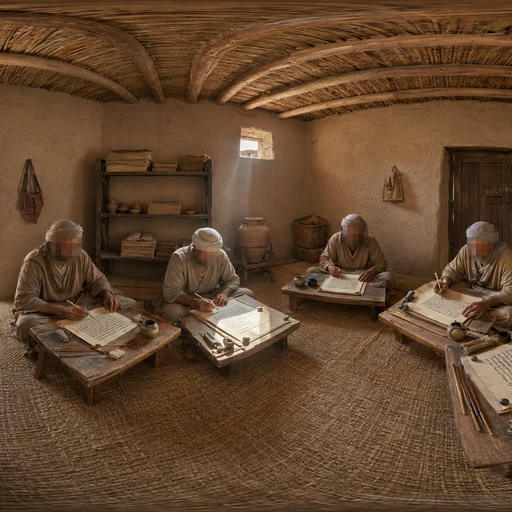
The Standardization of the Mushaf
c. 30 AH / c. 650 CE

Umar's Diwan and the Hijri Calendar
c. 17 AH / 638 CE

Ibn al-Zubayr Rebuilds the Kaaba
64 AH / 683 CE

After the Qarmatian Raid on Makkah
Dhul Hijja 317 AH / 930 CE

The Arbitration at Dumat al-Jandal
Ramadan 37 AH / February 658 CE
Guess places like this in GeoSiyer
Drop into a 360° scene from Islamic history and pin where, and when, it happened.
Play GeoSiyer