The First Mosque of the Philippines
Islam reaches the Sulu Sea, c. 1380 CE
c. 782 AH / 1380 CE
 Educational historical reconstruction
Where
Simunul island, in the Sulu archipelago
4.7500, 119.8400 · View on OpenStreetMap
Background
Islam came to the southern islands of what are now the Philippines, like its coming to the rest of the Malay archipelago, along the sea-roads of trade and through the work of missionaries and teachers, generations before any European sailed into these waters. By tradition the faith was first established in the Sulu archipelago, the chain of islands in the warm, shallow sea between Borneo and Mindanao, about the year 1380, when an Arab teacher and missionary known as Karim al-Makhdum (rahimahu Allah), a man of religion who came in the manner of the trader-preachers of the Indian Ocean, reached the island of Simunul. He settled among its people, taught them Islam, and built there a simple mosque, an open prayer-house of timber whose roof of palm thatch was carried on four great pillars of hardwood. The memory of his coming is preserved in the Tausug tarsila, the genealogical chronicles of Sulu that the people of the archipelago kept and recited, which name Karim al-Makhdum among the earliest bringers of the faith and remember Simunul as the place where it began. This is honoured as the first mosque in all the Philippine islands, and Simunul as the cradle of Islam in the land. From this beginning the faith spread through the islands of Sulu and on toward the great island of Mindanao, and within a century or so there arose the Muslim sultanates of Sulu and Maguindanao, which would rule the southern islands and resist, for centuries, the Spanish who came later to colonise the archipelago and to whom the Muslims of the south, the people the Spanish called Moros, never wholly submitted. The original mosque has been rebuilt many times, but its four ancient hardwood pillars are kept and revered as the root of the faith in the land. This scene depicts the early mosque on its island in the Sulu Sea, with the boats of the sea-traders drawn up on the beach and the island community gathered about the prayer-house. In keeping with the project's ethics any figure is anonymous and at a distance.
What you see
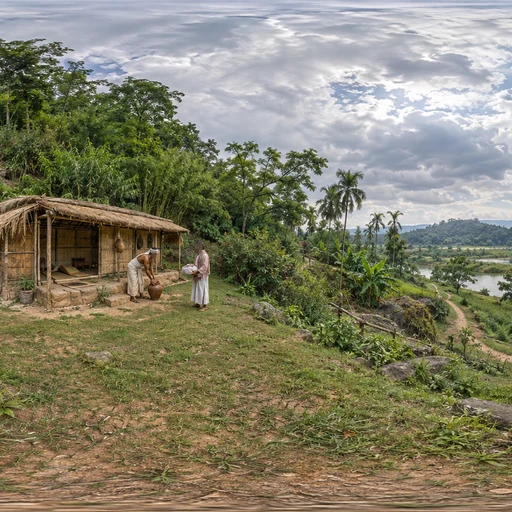
An open prayer-house of timber stands on the sand, its roof of palm thatch carried on stout hardwood posts; broad wooden steps climb to its doorway, and there is no dome and no minaret, only the simple post-and-beam frame of an early island mosque.
The mosque sits on a thin white beach at the edge of a warm, shallow, turquoise sea, ringed by coconut palms; this is a small island near the equator, at the far southern edge of a great archipelago and out toward the seas between Borneo and Mindanao.
Dugout and outrigger boats are drawn up on the shore, the craft of fishermen and sea-traders; the faith here came not by conquest but along the sea-roads of Indian Ocean trade, carried by Muslim merchants and teachers.
Around the prayer-house the island people are gathered with clay water-jars, woven baskets and mats; the missionary came among them as a trader and a man of religion, settling in the community and teaching them the faith.
This is honoured as the first mosque of the Philippine islands, founded about 1380 on the island of Simunul by an Arab teacher, Karim al-Makhdum (rahimahu Allah), who crossed the seas and brought Islam to the people of Sulu, the beginning of the faith in these islands.
The roof is held up by four great hardwood pillars; these are honoured as the original posts of that first mosque, kept and revered through every later rebuilding as the root of Islam in the land.
The mosque of Simunul, the cradle of Islam in the Philippines, is remembered in the Tausug tarsila, the genealogical chronicles of Sulu, generations before any European reached these shores. The scene depicts the early mosque and its island community; no individual is shown by likeness.
Further reading & cross-references
The Tausug tarsila and Philippine Muslim traditions of the coming of Islam to Sulu: The genealogical chronicles of Sulu and local Muslim tradition; used for Karim al-Makhdum, the founding of the mosque and the cradle of Islam at Simunul. Confidence medium (the tarsila blend history and hagiography).
The Sheikh Karim al-Makhdum Mosque, Simunul (extant, rebuilt around its original pillars): The primary site. Used for the mosque, its four hardwood pillars and the island setting. Confidence medium-high.
Standard histories of the coming of Islam to the Philippines and the Sultanates of Sulu and Maguindanao: Used for the sea-borne spread of Islam through the southern islands and the rise of the Muslim sultanates. Confidence high.
The Sulu archipelago (geographic and material context): The shallow island sea, the white beach, the outrigger boats and the timber-on-posts construction constrain the depiction. Confidence high.
Questions & answers
- Where is The First Mosque of the Philippines?
- Simunul island, in the Sulu archipelago
- When did it happen?
- c. 782 AH / 1380 CE
- What is the story of The First Mosque of the Philippines?
- Islam came to the southern islands of what are now the Philippines, like its coming to the rest of the Malay archipelago, along the sea-roads of trade and through the work of missionaries and teachers, generations before any European sailed into these waters. By tradition the faith was first…
Related places



Guess places like this in GeoSiyer
Drop into a 360° scene from Islamic history and pin where, and when, it happened.
Play GeoSiyer