The Founding of the Sokoto Caliphate
Usman dan Fodio's reform movement in Hausaland, 1804
1219 AH / 1804 CE
 Educational historical reconstruction
Where
Hausaland, the Gudu and Sokoto country (northern Nigeria)
13.0600, 5.2400 · View on OpenStreetMap
Background
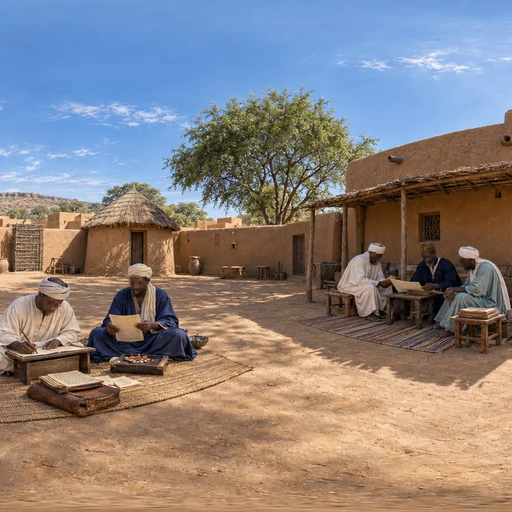
In 1804 (1219 AH) the Fulani scholar Usman dan Fodio (rahimahu Allah), known to his followers as the Shehu, a teacher of the Maliki school and the Qadiri Sufi way, launched in the Hausa country of what is now northern Nigeria the reform movement that founded the Sokoto Caliphate. For years he had preached tajdid, the renewal of the Sunna, and the removal of practices he judged to be innovations and of the injustice and mixed religion of the Hausa kings. When his relations with Yunfa, the king of Gobir, broke down, he and his community withdrew, a hijra in conscious imitation of the Prophet Muhammad's (peace and blessings be upon him) emigration, to Gudu, where his followers gave him the bay'a and proclaimed him Amir al-Mu'minin, Commander of the Faithful. From there he led a jihad against the Hausa rulers between 1804 and about 1808 that brought most of Hausaland and lands beyond under the new state. Its capital was later established at Sokoto, founded under his son, and it grew into a confederation of emirates that was one of the largest states in nineteenth-century Africa. The movement was led throughout by scholars: the Shehu himself, his brother Abdullahi dan Fodio and his son Muhammad Bello (rahimahum Allah), all of them prolific authors who set out the aims and the law of the new state in their writings, and its learning extended to women, among them the Shehu's daughter Nana Asma'u (rahimaha Allah), a poet and teacher in her own right. The founder's own Bayan Wujub al-Hijra ala al-Ibad makes the duty of hijra and the legal basis of the movement plain; Muhammad Bello's Infaq al-Maysur and Abdullahi's Tazyin al-Waraqat narrate the withdrawal to Gudu and the campaigns. It must be said plainly that this was warfare waged among people who professed Islam, the reformers holding that the existing order had departed from the Sunna and the Shariah, and the history is read in more than one way. The caliphate endured until the British conquest of 1903. This scene depicts the reform community gathered at its mud-brick settlement in the savannah, the scholars teaching under an awning while the banner-bearing horsemen of the jihad stand by, the learning and the arms of the movement in one place.
What you see
Dry grassland with flat-topped acacia and scattered trees runs to a wide horizon under a high blue sky, dry-season savannah. This is the Sudanic belt of West Africa, the Hausa country of the central Sahel, neither desert sand nor rainforest.
Behind the gathering stands a town of sun-dried mud brick, banco, with a mosque whose buttressed facade carries pointed pinnacles and rows of projecting wooden beams. This is the Sudano-Sahelian building tradition of the western Sudan, not Arabian stone or North African tile.
A round mud-brick well with a low parapet stands in the foreground, and woven baskets, mats, pottery and sandals are set out around it. The marks of a settled community at its watering place, not a passing camp.
Under a broad cloth awning a circle of scholars in white and indigo robes sits on woven mats with open manuscripts, bound books and wooden writing-boards. The movement is led from a place of learning, with the Qur'an and the books of the law at its heart.
To one side mounted men hold tall standards, green and gold banners raised above the horses of the community's cavalry. The flag-bearers of a jihad gathered beside the teaching, arms and learning together in one movement.
Crowds of followers, families and herders press in around the seated circle from every side. A whole people has come together around its scholar-leader, not an army alone on campaign.
A reforming community that has withdrawn from the old towns in a hijra and rallied around a scholar proclaimed its commander is the seed of a new Islamic state, founded by revival and not by an existing ruling house.
Further reading & cross-references
Usman dan Fodio, Bayan Wujub al-Hijra ala al-Ibad and Ihya al-Sunna wa-Ikhmad al-Bid'a (early 19th c.): The founder's own works setting out the duty of hijra, the programme of reviving the Sunna and suppressing innovation, and the legal basis of the movement. The primary statement of its aims, from within. Confidence high for the movement's self-understanding.
Muhammad Bello, Infaq al-Maysur fi Tarikh Bilad al-Takrur (early 19th c.): The history of the jihad by the Shehu's son and successor as caliph. The principal narrative source for the hijra to Gudu, the bay'a and proclamation, and the campaigns. A participant and partisan, so read with that in mind. Confidence high for the sequence.
Abdullahi dan Fodio, Tazyin al-Waraqat (early 19th c.): The verse-and-prose account by the Shehu's brother; supports the early history of the community, the withdrawal and the reform programme.
Mervyn Hiskett, The Sword of Truth: The Life and Times of the Shehu Usuman dan Fodio (OUP, 1973): Standard modern biography. Used for the chronology, the scholarly background, the break with Gobir, the founding of the state and the place of women scholars such as Nana Asma'u. Confidence high.
Murray Last, The Sokoto Caliphate (Longmans, 1967): The standard modern history of the caliphate's formation and government. Used for the structure of the new state, the founding of Sokoto and the emirate confederation.
Questions & answers
- Where is The Founding of the Sokoto Caliphate?
- Hausaland, the Gudu and Sokoto country (northern Nigeria)
- When did it happen?
- 1219 AH / 1804 CE
- What is the story of The Founding of the Sokoto Caliphate?
- In 1804 (1219 AH) the Fulani scholar Usman dan Fodio (rahimahu Allah), known to his followers as the Shehu, a teacher of the Maliki school and the Qadiri Sufi way, launched in the Hausa country of what is now northern Nigeria the reform movement that founded the Sokoto Caliphate. For years he had…
Related places


Guess places like this in GeoSiyer
Drop into a 360° scene from Islamic history and pin where, and when, it happened.
Play GeoSiyer