The Salt Mines of Taghaza
A desert town built of salt, c. 1352 CE
c. 753 AH / 1352 CE
 Educational historical reconstruction
Where
Taghaza, in the Sahara, north of the Niger lands
23.5667, -4.9833 · View on OpenStreetMap
Background
Taghaza was a salt-mining settlement in the midst of the western Sahara, in the empty desert north of the Niger lands, and one of the strangest and most desolate inhabited places of the medieval world. Here, in a region without trees, grass or running water, rich beds of rock-salt lay near the surface, and the salt was dug out in great slabs and loaded onto camels to be carried hundreds of miles southward across the desert to the trading-cities of the Sudan. Salt was scarce and precious in the lands of West Africa and was prized almost as highly as gold; and the trans-Saharan trade turned upon the exchange of the two, the salt of the desert mines passing south and the gold of the Mali goldfields passing north, with Taghaza as the northern pole of that commerce. The place was so barren that the very houses and the mosque were built of blocks of salt, roofed with camel-hides, and the labourers who worked the mines, often slaves, depended wholly on the caravans to bring them food, for nothing could be grown there. The great traveller Ibn Battuta passed through Taghaza about 1352 on his way to the empire of Mali and left a famous description of it, marvelling that so wretched a spot should be the source of such wealth. This scene depicts the salt-town of Taghaza and a caravan loading for the southward crossing. In keeping with the project's ethics any figure is anonymous and at a distance.
What you see
A wretched settlement stands alone in the midst of an utterly barren desert, no tree nor blade of grass nor running water in sight, only sand and glaring sky; one of the most desolate inhabited places on earth.
Strangest of all, the very houses and the mosque are built of slabs of rock-salt, roofed with camel-hides, for there is no other building stone; the place is a salt-mine, and salt is dug here in great blocks out of the ground.
This is Taghaza, the famous salt-mining station of the Sahara, where the slabs of salt were cut that the caravans carried south to the lands of the Sudan, there to be exchanged weight for weight, almost, against the gold of Mali.
Camel caravans halt at the wells to load the salt and to take on water for the deadly crossing ahead; the labourers who dig the salt are sustained only by the caravans that bring them dates and grain from afar, for nothing grows here.
The traveller who passed this way marvelled that so miserable a place should be the source of such wealth, the northern pole of the great trade by which the salt of the desert was bartered for the gold of the south.
Ibn Battuta's description of Taghaza is one of the chief accounts of it. The scene depicts the salt-town and a caravan; no individual is shown by likeness.
Further reading & cross-references
Ibn Battuta, Rihla (the Travels, 14th c.), the account of Taghaza: The primary eyewitness source. Used for the salt-block houses, the mines and the desolation. Confidence high for the account.
Histories of the trans-Saharan salt and gold trade: Used for the salt-for-gold exchange, the caravans and Taghaza's place in the trade. Confidence high.
Arabic geographers of the western Sudan (al-Bakri, al-Umari; cross-reference): Used for the Saharan trade routes and the salt sources. Confidence medium-high.
The site of Taghaza in the Sahara (geographic context): The desert setting and the salt diggings constrain the depiction; the exact site and its remains are sparse.
Questions & answers
- Where is The Salt Mines of Taghaza?
- Taghaza, in the Sahara, north of the Niger lands
- When did it happen?
- c. 753 AH / 1352 CE
- What is the story of The Salt Mines of Taghaza?
- Taghaza was a salt-mining settlement in the midst of the western Sahara, in the empty desert north of the Niger lands, and one of the strangest and most desolate inhabited places of the medieval world. Here, in a region without trees, grass or running water, rich beds of rock-salt lay near the…
Related places

The Koutoubia of Marrakesh
c. 550s-590s AH / 1150s-1190s CE

The Kutubiyya Minaret of Marrakesh
Almohad (581-595 AH / 1185-1199 CE)
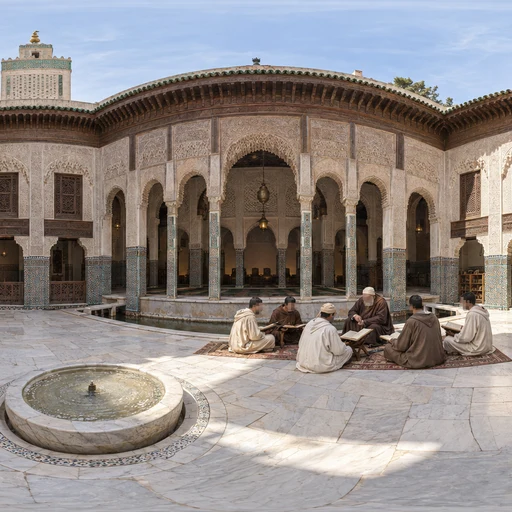
The Bou Inania Madrasa, Fez
c. 756 AH / 1355 CE

The Battle of the Three Kings
986 AH / 1578 CE

The Alhambra of Nasrid Granada
c. 772 AH / c. 1370 CE

The Generalife Garden
731 AH / c. 1330 CE
Guess places like this in GeoSiyer
Drop into a 360° scene from Islamic history and pin where, and when, it happened.
Play GeoSiyer