The Edict of Gulhane
The Tanzimat reforms proclaimed at Istanbul, 1839 CE
1255 AH / 1839 CE
 Educational historical reconstruction
Where
Gulhane, by the Topkapi Palace, Istanbul
41.0131, 28.9813 · View on OpenStreetMap
Background
By the early nineteenth century the Ottoman Empire, beset by military defeats, by the loss and rebellion of provinces and by the growing pressure and interference of the European powers, was widely felt to be in danger, and its statesmen sought to reform and strengthen it by remaking its institutions on more modern lines. In 1839, in the rose-garden of Gulhane beside the Topkapi Palace, before an assembly of ministers, ulama, foreign ambassadors and notables, the great reforming statesman Mustafa Reshid Pasha read out, in the name of the young Sultan Abdulmecid (rahimahu Allah), a solemn imperial edict, the Hatt-i Sharif of Gulhane, which opened the era of reform known as the Tanzimat, the Reordering. The edict promised to all the subjects of the empire, of whatever religion, security of life, honour and property, an end to arbitrary execution and confiscation, the regular and fair assessment of taxes in place of the old and oppressive tax-farming, and an orderly system of conscription, and it proclaimed the principle that the state would henceforth be governed by fixed laws. Over the following decades the Tanzimat reforms remade much of the Ottoman administration, law, army, education and finance along modern and partly European lines. The reforms were a genuine and in many ways necessary effort to save and renew the empire and to give its peoples justice and security; yet they were carried out under heavy European pressure and influence, they provoked resistance from those whose interests and traditions they overturned, and they could not in the end halt the empire's long decline. The Tanzimat is therefore remembered as a great and double-edged turning-point, the beginning of the Ottoman state's struggle to modernise itself in a hostile age. This scene depicts the proclamation of the edict at Gulhane in 1839. In keeping with the project's ethics any figure is anonymous and at a distance, and the scroll is not legible.
What you see
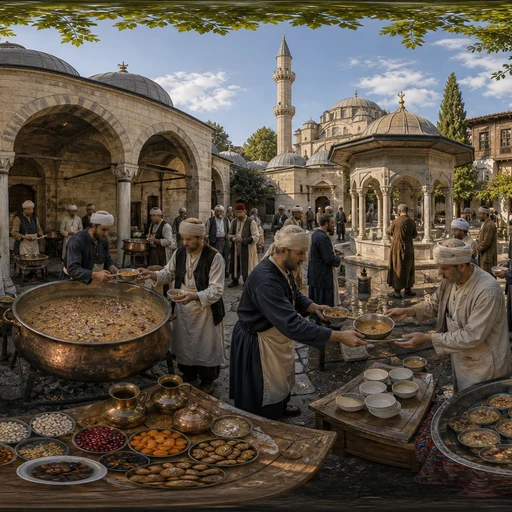
In a garden beside the great old palace, before an assembly of officials, foreign envoys and notables, a minister reads aloud a solemn decree from an unrolled scroll; a public proclamation of a new charter for the state.
The men of the court wear not the old robes and turbans but the new dress of reform, the brimless red fez and the dark European frock-coat; the very clothes announce that this is an age of modernisation.
This is the proclamation of the Edict of Gulhane in 1839, the charter that opened the Tanzimat, the great reordering by which the Ottoman state, under Sultan Abdulmecid (rahimahu Allah), sought to reform and modernise itself in the hope of arresting its decline.
The edict promises to all the sultan's subjects security of life, honour and property, an end to arbitrary punishment, fair and regular taxation in place of the old tax-farming, and orderly conscription; the foundations, it is hoped, of a modern and just state.
The scene is the imperial capital on its strait between two continents, the palaces and mosques of the old city above the water, the seat of the Ottoman sultans and caliphs.
The Edict of Gulhane and the Tanzimat reforms are recorded in the Ottoman archives and histories. The scene depicts the proclamation; no individual is shown by likeness, and the text of the scroll is not legible.
Further reading & cross-references
The text of the Hatt-i Sharif of Gulhane (1839) and the Ottoman archives: The primary document. Used for the content and promises of the edict. Confidence high.
Histories of the Tanzimat and of the late Ottoman Empire: Used for the context, the reforms, Mustafa Reshid Pasha and Sultan Abdulmecid, and the consequences. Confidence high.
Studies of Ottoman modernisation and European pressure: Used for the double-edged character of the reforms and the foreign context. Confidence high.
Gulhane and the Topkapi Palace, Istanbul (material/geographic context): The garden, the palace and the period dress constrain the depiction.
Questions & answers
- Where is The Edict of Gulhane?
- Gulhane, by the Topkapi Palace, Istanbul
- When did it happen?
- 1255 AH / 1839 CE
- What is the story of The Edict of Gulhane?
- By the early nineteenth century the Ottoman Empire, beset by military defeats, by the loss and rebellion of provinces and by the growing pressure and interference of the European powers, was widely felt to be in danger, and its statesmen sought to reform and strengthen it by remaking its…

Guess places like this in GeoSiyer
Drop into a 360° scene from Islamic history and pin where, and when, it happened.
Play GeoSiyer