The Translators of Toledo
Arabic learning passes to Europe, c. 1150 CE
c. 545 AH / 1150 CE
 Educational historical reconstruction
Where
Toledo, on the Tagus, in central Iberia
39.8567, -4.0245 · View on OpenStreetMap
Background
Toledo, a city on a rocky bend of the Tagus in the heart of the Iberian peninsula, had been a centre of Muslim al-Andalus, rich in Arabic libraries, before it passed to Christian rule in 1085; and it became, over the twelfth century, the most important of the gateways through which the scientific and philosophical heritage of the Arabic-Islamic world was translated into Latin and carried into the rest of Europe. In the libraries and studies of the city, scholars of the three faiths, Jewish, Christian and Muslim, worked together at the labour of translation: a man who knew Arabic would read a book and render it into the common Romance speech, and another would set it down in Latin, so that the great works of Arabic science and philosophy, the astronomy, mathematics, medicine, optics and the rest, together with the books of the Greek philosophers that the Muslims had preserved, enlarged and commented upon, were made available to the Latin world. Through Toledo and a few other channels, the works of al-Khwarizmi and the algebra, of Ibn Sina in medicine, of Ibn Rushd on Aristotle, and of many others, entered the schools and the new universities of Europe and helped to set in motion its own intellectual awakening. This scene depicts the work of translation at Toledo: scholars of different dress and faith over their manuscripts, an Arabic book being read and rendered, astronomical tables and an astrolabe and the treatises of the sciences on the desks. In keeping with the project's ethics any figures are anonymous and at a distance.
What you see
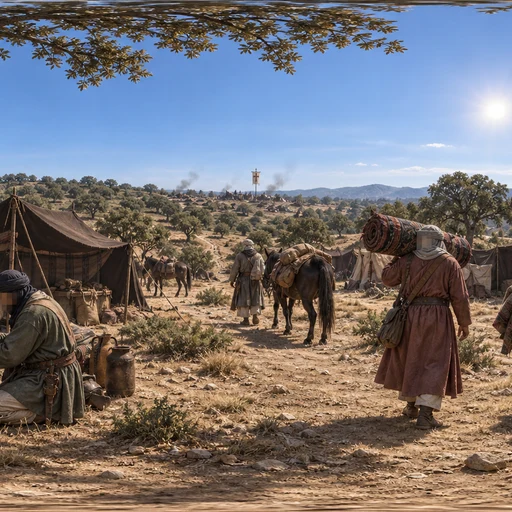
A study where scholars of different dress and faith work together over manuscripts, one reading aloud from an Arabic book and rendering it into a common tongue while another writes it down in Latin; the labour of translation across languages.
On the desks lie scientific and philosophical works, astronomical tables and an astrolabe, treatises of medicine, mathematics and the books of the Greek philosophers preserved and enlarged in Arabic.
This is the translation movement at Toledo, a city of central Iberia recently passed from Muslim to Christian rule, where over the twelfth century the great scientific and philosophical heritage of the Arabic-Islamic world was translated into Latin and carried into Europe.
The city stands on a rocky bend of a river in the heart of the peninsula, its libraries full of the Arabic books of al-Andalus; Jewish, Christian and Muslim scholars laboured here side by side on the work of transmission.
Through Toledo and a few other gateways the learning that the Muslims had gathered and advanced, the Greek inheritance, Arabic science, the works of al-Khwarizmi, Ibn Sina and Ibn Rushd, entered the schools of Europe and helped to kindle its own awakening.
The Toledo translators and the passage of Arabic learning to the Latin West are recorded in the history of medieval science. The scene depicts the work of translation, with no individual shown by likeness.
Further reading & cross-references
Histories of the Toledo translation movement and medieval science: Used for the translators, the work of rendering Arabic into Latin, and the passage of learning to Europe.
Accounts of the Arabic libraries of al-Andalus and Toledo: Used for the books of al-Andalus that were the material of the translations.
Studies of the transmission of Greek and Arabic science to the Latin West: Used for the works translated (al-Khwarizmi, Ibn Sina, Ibn Rushd) and their effect on Europe. Non-confessional cross-reference.
The setting of medieval Toledo (material context): The city on the Tagus constrains the depiction; the specific study is representative.
Questions & answers
- Where is The Translators of Toledo?
- Toledo, on the Tagus, in central Iberia
- When did it happen?
- c. 545 AH / 1150 CE
- What is the story of The Translators of Toledo?
- Toledo, a city on a rocky bend of the Tagus in the heart of the Iberian peninsula, had been a centre of Muslim al-Andalus, rich in Arabic libraries, before it passed to Christian rule in 1085; and it became, over the twelfth century, the most important of the gateways through which the scientific…
Related places



Guess places like this in GeoSiyer
Drop into a 360° scene from Islamic history and pin where, and when, it happened.
Play GeoSiyer