The Renewal under Umar II
Restitution and the order to record hadith, 99-101 AH
Umar II (99-101 AH / 717-720 CE)
 Educational historical reconstruction
Where
A caliphal country estate in Umayyad Syria, near Damascus
33.4500, 36.5500 · View on OpenStreetMap
Background
Umar ibn Abd al-Aziz (rahimahu Allah), the Umayyad caliph who reigned only from 99 to 101 AH (717-720 CE), is remembered in the Sunni tradition with a reverence reserved for almost no other ruler of his house, a great-grandson of Umar ibn al-Khattab (RA) through his mother, and so esteemed for his justice that later scholars often counted him a renewer (mujaddid) of the religion and even, in affection, a fifth among the rightly-guided. His short caliphate was a deliberate reform of the Umayyad state from within. He opened the registers of grievances (mazalim) and returned estates and revenues that the ruling family and its governors had taken unjustly, beginning with his own kin and his own property. He reformed the taxes: he ended the abuse by which non-Arab converts to Islam (the mawali) were still made to pay the tribute of non-Muslims, holding that Islam, not lineage, fixed a believer's obligations, a measure of fiscal justice with deep social consequences. He ordered an end to the cursing of Ali ibn Abi Talib (RA) that had been pronounced from Umayyad pulpits, replacing it with the recitation of the Qur'anic verse enjoining justice and excellence (al-Nahl 16:90). And, fearing that the death of the Companions' students would carry away the Prophet's reports with them, he gave the order that would shape the whole later science of hadith: he instructed his governor of Madinah, Abu Bakr ibn Hazm, and the great scholar Ibn Shihab al-Zuhri (rahimahu Allah) to gather and write down the hadith, the first state-sponsored codification of the Sunna, noted in the introduction to Sahih al-Bukhari. He lived austerely, restraining the treasury and his own household. The reforms outlasted him only in part, his successors reversed much of the fiscal program, but his reputation as the just caliph endured across the Sunni centuries. He governed often from his estates in the Syrian countryside rather than from the palaces of Damascus. A clerk receives a visitor beside papers, coins and a balance in a plain stone courtyard. These objects suggest administration; the documents cannot establish a particular tax decision. Tradition credits Umar II with ordering the collection of hadith. This is background to his reign, not an identifiable manuscript being copied in the Syrian courtyard.
What you see
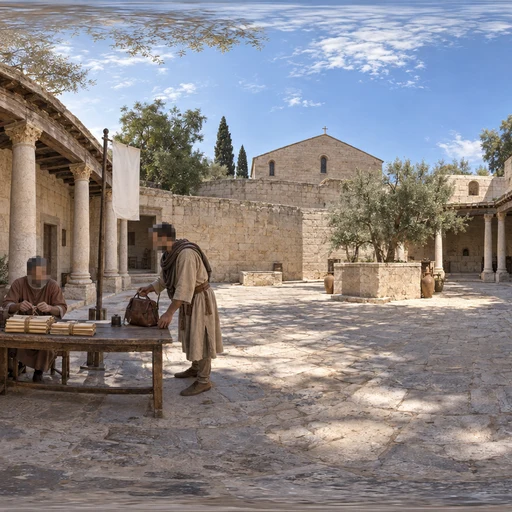
A modest dressed-stone estate at the edge of the Syrian steppe, a small audience hall and plain courtyard rather than a grand palace, the restrained residence of a caliph remembered for living austerely and governing from the countryside rather than the capital.
A clerk receives a visitor beside papers, coins and a balance in a plain stone courtyard. These objects suggest administration; the documents cannot establish a particular tax decision.
A waiting visitor and working clerk suggest a petition or administrative exchange. The visitor’s ancestry and the outcome of the case are not visible.
Tradition credits Umar II with ordering the collection of hadith. This is background to his reign, not an identifiable manuscript being copied in the Syrian courtyard.
Accounts associate Umar II with reform of the Friday sermon. The panorama instead shows everyday administration; no sermon is being performed.
Coins and a balance suggest weighing or accounting. Individual legends and denominations are too small to authenticate.
The banners over the estate are white, the colour of the house of Umayya, this is reform from within the dynasty, not against it, two generations before the black banners of the Abbasids.
Primary sources
Ibn Sa'd, al-Tabaqat al-Kubra (9th c.): Biographical compilation with material on Umar II. Used for his reforms and reputation among the early scholars. Confidence high.
Sahih al-Bukhari (introduction / muallaq report on writing hadith): Tradition credits Umar II with ordering the collection of hadith. This is background to his reign, not an identifiable manuscript being copied in the Syrian courtyard.
al-Tabari, Tarikh al-Rusul wa-al-Muluk (early 10th c.): Principal Sunni narrative history. Places the reign in its political setting and records the reversal of much of the program by his successors. Confidence high for sequence.
Further reading & cross-references
Ibn Abd al-Hakam, Sirat Umar ibn Abd al-Aziz (9th c.): Early dedicated Sunni biography of Umar II by an Egyptian scholar. Principal source for his restitutions, fiscal reforms, austerity, and conduct in office. Confidence high for the portrait, devotional in tone as befits its subject.
Abu Yusuf, Kitab al-Kharaj (8th c.): Foundational Hanafi work on fiscal administration. Used for the principles behind the tax reforms (the treatment of converts and the kharaj) that Umar II pressed. Confidence high for the legal framework.
Umayyad rural estates and reformed coinage (material record): Material cross-reference. The dressed-stone country estates of Umayyad Syria and the post-reform aniconic dinars/dirhams in circulation fix the setting and the period. Confidence high for the material frame.
Questions & answers
- Where is The Renewal under Umar II?
- A caliphal country estate in Umayyad Syria, near Damascus
- When did it happen?
- Umar II (99-101 AH / 717-720 CE)
- What is the story of The Renewal under Umar II?
- Umar ibn Abd al-Aziz (rahimahu Allah), the Umayyad caliph who reigned only from 99 to 101 AH (717-720 CE), is remembered in the Sunni tradition with a reverence reserved for almost no other ruler of his house, a great-grandson of Umar ibn al-Khattab (RA) through his mother, and so esteemed for his…
Related places



Guess places like this in GeoSiyer
Drop into a 360° scene from Islamic history and pin where, and when, it happened.
Play GeoSiyer