The Garden of Death at Yamama
The climax of the Ridda wars against Musaylima, Najd, 12 AH
12 AH / 633 CE
 Educational historical reconstruction
Where
'Aqraba in al-Yamama, the oasis of Banu Hanifa, central Najd
24.4500, 46.9500 · View on OpenStreetMap
Background
In the twelfth year after the Hijra (633 CE), during the caliphate of Abu Bakr al-Siddiq (radiyallahu 'anhu), the Muslim army under Khalid ibn al-Walid (radiyallahu 'anhu) fought the decisive battle of the wars of apostasy (hurub al-ridda) at 'Aqraba in al-Yamama, the central-Najdi oasis homeland of the Banu Hanifa. After the death of the Prophet (peace and blessings be upon him), several Arabian tribes withheld allegiance or followed claimants to prophethood; the most dangerous was Musaylima ibn Habib (called by the Muslims al-Kadhdhab, "the liar"), who had built a substantial following among the Banu Hanifa. Abu Bakr (RA) prosecuted the campaigns to restore the unity of the community; after Khalid (RA) had dealt with Tulayha at Buzakha, he turned to Yamama, where the fighting was the fiercest of all the ridda engagements. The classical sources, al-Tabari, al-Baladhuri's Futuh al-Buldan, Ibn Kathir, and Ibn al-Athir's al-Kamil, drawing in part on Sayf ibn 'Umar's transmissions and al-Waqidi's Kitab al-Ridda, record that the hard-pressed Banu Hanifa fell back into a great walled garden and barred it; the Companion al-Bara' ibn Malik (RA) had himself lifted over the wall on shields to open the gate, and the enclosure, where Musaylima and great numbers of his men were killed, was afterwards called Hadiqat al-Mawt, "the Garden of Death." Musaylima himself was killed at the wall, the sources naming Wahshi ibn Harb together with an Ansari among those who struck him. Muslim losses were heavy and included a large number of those who had memorised the Qur'an; the tradition (preserved in Sahih al-Bukhari) records that this loss moved 'Umar (RA) to urge Abu Bakr (RA) to have the Qur'an collected into a single written copy, the task entrusted to Zayd ibn Thabit (RA). This scene depicts the aftermath at the breached garden wall, the fighting over and the cost of it visible, soberly and without graphic detail.
What you see
A long enclosing wall of mud brick and rough fieldstone rings a walled date-palm garden, a hadiqa of the Yamama oasis. One stretch of the wall has been broken open from outside; the breach, not a city gate, is the focus, marking where the fighting was forced into the enclosure.
Dense date palms inside the wall give way immediately to the open gravel steppe of central Najd beyond, the high plateau of inner Arabia, far from any coast or great river. This is the heartland oasis of the Banu Hanifa, not the Hijaz of Makkah and Madinah.
Scattered Arabian war gear lies where it fell, palm-fibre and hide shields, simple iron-tipped spears, plain crossbelts and quivers. There is no Byzantine lamellar nor Sasanian scale armour: this is an inter-Arabian fight of the apostasy wars, before the great campaigns into Syria and Iraq.
The shattered gate of the garden tells the story the sources record: the defenders withdrew into the walled enclosure and barred it, and an attacking warrior had himself hoisted on a shield over the wall to open the gate from within, after which the garden became a killing ground and earned its grim later name.
Reed pens, a broken inkwell, and a few loose written leaves lie trampled among the fallen, a deliberate visual echo of the tradition that a large number of those who had memorised the Qur'an (the qurra') were killed here, the loss that prompted the first collection of the Qur'an into a single written copy.
The light is the hard white sun of the Najdi interior over pale limestone gravel. The campaign belongs to the cool months of the twelfth year after the Hijra (633 CE), in the second year of the caliphate of Abu Bakr al-Siddiq (radiyallahu 'anhu).
Beaten tracks converge on the oasis from the north-west, the line of march of the army sent from Madinah under Khalid ibn al-Walid (radiyallahu 'anhu) after earlier engagements at Buzakha and elsewhere in the suppression of the apostasy.
Primary sources
al-Tabari, Tarikh al-Rusul wa-al-Muluk (10th c.): The principal connected narrative of the ridda wars, drawing on the transmissions of Sayf ibn 'Umar among others. Provides the sequence of the campaign, the walled-garden episode, and the death of Musaylima. Sayf's reports are used where corroborated within the Sunni tradition.
al-Baladhuri, Futuh al-Buldan (9th c.): Early Sunni conquest history. Independent summary of the Yamama campaign and its outcome, useful as a check on al-Tabari's fuller narrative.
Sahih al-Bukhari, Kitab Fada'il al-Qur'an (9th c.): Cited for the link between the heavy losses among the qurra' at Yamama and the first collection of the Qur'an under Abu Bakr (RA) through Zayd ibn Thabit (RA), the report in which 'Umar (RA) presses the caliph to act.
Ibn al-Athir, al-Kamil fi al-Tarikh (13th c.): Synthesises the earlier accounts into a clear ordered narrative of the ridda; used as a cross-check on the chronology and the named participants.
Ibn Kathir, al-Bidaya wa al-Nihaya (14th c.): Sunni synthesis; confirms the dating in 12 AH, the role of Khalid (RA), the al-Bara' ibn Malik (RA) episode at the wall, and the casualties.
al-Waqidi (attrib.), Kitab al-Ridda (8th-9th c.): Early maghazi-style monograph on the apostasy wars. Used with caution for circumstantial detail; al-Waqidi's chronology is generally accepted while individual reports are weighed against the stronger sources.
Questions & answers
- Where is The Garden of Death at Yamama?
- 'Aqraba in al-Yamama, the oasis of Banu Hanifa, central Najd
- When did it happen?
- 12 AH / 633 CE
- What is the story of The Garden of Death at Yamama?
- In the twelfth year after the Hijra (633 CE), during the caliphate of Abu Bakr al-Siddiq (radiyallahu 'anhu), the Muslim army under Khalid ibn al-Walid (radiyallahu 'anhu) fought the decisive battle of the wars of apostasy (hurub al-ridda) at 'Aqraba in al-Yamama, the central-Najdi oasis homeland…
Related places

The Battle of the Camel
10 Jumada al-Akhira 36 AH / 7 December 656 CE

The Zanj Rebellion in the Marshes
Zanj Rebellion (255-270 AH / 869-883 CE)

Umar's Diwan and the Hijri Calendar
c. 17 AH / 638 CE

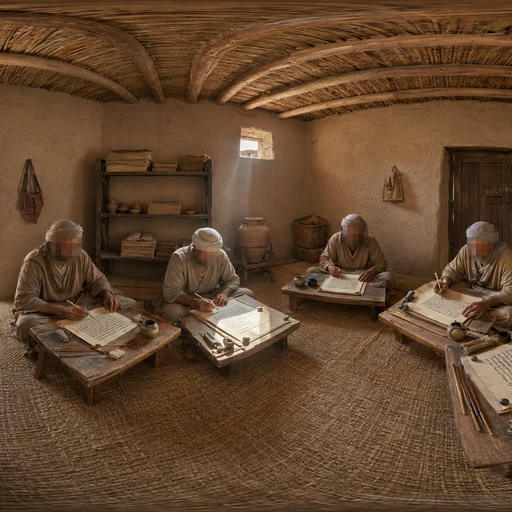
The First Collection of the Qur'an
12 AH / 633 CE
The Standardization of the Mushaf
c. 30 AH / c. 650 CE

The Saqifa of Banu Sa'idah
11 AH / 632 CE
Guess places like this in GeoSiyer
Drop into a 360° scene from Islamic history and pin where, and when, it happened.
Play GeoSiyer