The Young Turk Revolution
The constitution restored in Istanbul, 1908
1326 AH / 1908 CE
 Educational historical reconstruction
Where
Istanbul, by the Bosphorus
41.0080, 28.9780 · View on OpenStreetMap
Background
In July 1908 a movement of reformist officers and officials, loosely called the Young Turks and led by the Committee of Union and Progress (the Ittihat ve Terakki), rose in the Ottoman Balkan provinces of Macedonia and forced Sultan Abdulhamid II to restore the constitution of 1876, which he had suspended for some thirty years, and to recall the parliament, opening what Ottomans called the Second Constitutional Era. The movement's strength lay in the Third Army officers stationed in Rumelia, who marched their units out in defiance of the palace; when the sultan-caliph yielded, the news ran by telegraph from the provinces to the capital and out across the empire. It was met with extraordinary jubilation: crowds poured into the squares of Istanbul and the provincial cities, banners and placards were raised in the streets, and for a brief season Muslims, Christians and Jews celebrated together under the slogans of liberty, equality, fraternity and justice, hailing what they hoped would be a new era of constitutional and shared Ottoman citizenship. M. Sukru Hanioglu's study of the Young Turk movement and Feroz Ahmad's account of the Committee in power trace both the conspiratorial preparation behind the rising and the politics that followed it. The hope was that constitutional government would halt the empire's decline and bind its peoples together; the reality proved harder. The Committee soon came to dominate politics; a counter-revolution in 1909 was put down and Abdulhamid II was deposed; and under the pressure of the Italian war over Libya, the Balkan Wars and the rise of competing nationalisms, the early promise of a liberal, multi-communal Ottomanism gave way to a narrower and increasingly authoritarian, Turkish-nationalist rule that would carry the empire into the First World War. The 1908 revolution is therefore remembered as a moment of great and genuine hope whose promise was not kept, a hinge between the long Hamidian era and the final decade of the empire. This scene depicts that first jubilation in a hillside square of Istanbul in the summer of 1908: a crowd massed with banners and placards before a telegraph office where the proclamation has been posted, with army officers in their red fezzes standing among the townspeople and the domes and minarets of the city rising across the strait beyond.
What you see
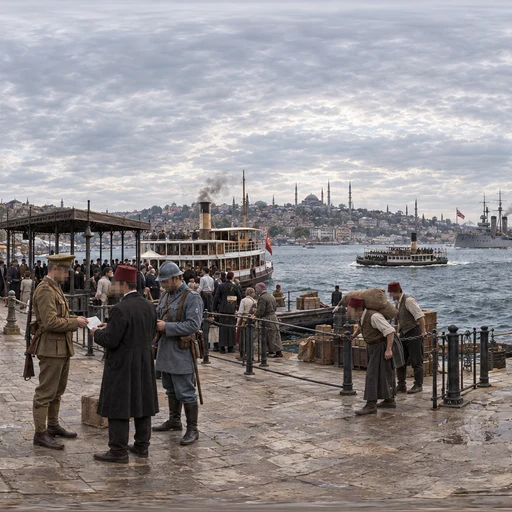
A cobbled square on a hillside opens downhill toward a broad strait. Across the water, domed mosques with slender pencil minarets and a great hilltop dome rise above the far shore, the unmistakable skyline of the Ottoman capital on the Bosphorus, where Europe meets Asia.
The square is packed with a dense, jubilant crowd rather than an angry one. There is no fighting and no wreckage; people press together to mark a political victory, with their attention turned toward a posted announcement and the speakers among them.
A masonry corner building on the left carries the word TELEGRAPHES carved over its doorway, with a printed notice fixed in a frame beside the door and a man pausing to read it. The telegraph office is where the proclamation has arrived and been posted for the public.
Above the heads of the crowd rise rows of plain placards and banners held aloft on poles, carried as slogans of liberty and unity. A red flag bearing a white crescent and star, the Ottoman standard, is lifted among them.
A block of soldiers in khaki field uniforms and red fezzes stands amid the civilians in frock coats and tasselled fezzes. Army officers, not only townspeople, are at the heart of the celebration, the mark of a movement carried by the military.
The buildings are tall masonry blocks with iron balconies, shuttered windows and carved stone door surrounds, a late Ottoman city of European-style apartment fronts and offices rather than timber houses, lit by the clear light of an early-twentieth-century summer day.
Crowds and officers gathered to greet a restored parliament and a revived constitution mark a revolution that forced a long personal autocracy to give way to constitutional rule, a moment of great hope whose promise would prove fragile.
Further reading & cross-references
Ottoman press and memoirs of 1908 (early 20th c.): The newspapers and memoirs of the constitutional revolution; used for the celebrations, the slogans, the role of the telegraph in spreading the news, and the political moment. Confidence high for the events.
M. Sukru Hanioglu, Preparation for a Revolution: The Young Turks 1902-1908 (2001): Standard modern study of the Young Turk movement, the role of the Macedonian officers, and the 1908 revolution. Used for the politics and the course of events. Confidence high.
Feroz Ahmad, The Young Turks (1969): Classic study of the Committee of Union and Progress in power. Used for the aftermath, the 1909 counter-revolution and the drift to CUP dominance. Confidence high.
Contemporary photographs of the 1908 celebrations (cross-reference): Period photographs of the crowds, banners, uniforms, fezzes and Ottoman flags constrain the look of the celebrations; used for material detail, not for framing.
Questions & answers
- Where is The Young Turk Revolution?
- Istanbul, by the Bosphorus
- When did it happen?
- 1326 AH / 1908 CE
- What is the story of The Young Turk Revolution?
- In July 1908 a movement of reformist officers and officials, loosely called the Young Turks and led by the Committee of Union and Progress (the Ittihat ve Terakki), rose in the Ottoman Balkan provinces of Macedonia and forced Sultan Abdulhamid II to restore the constitution of 1876, which he had…


Guess places like this in GeoSiyer
Drop into a 360° scene from Islamic history and pin where, and when, it happened.
Play GeoSiyer