Yunus and Nineveh Repenting
The city of Nineveh in mass repentance after the prophet's return (Q 10:98, 37:147-148)
The time of Yunus (peace be upon him), at Nineveh
 Educational historical reconstruction
Where
Nineveh (opposite Mosul), northern Iraq
36.3469, 43.1525 · View on OpenStreetMap
Background
The Qur'an records the prophet Yunus ibn Matta (peace be upon him), Yunus in the Qur'anic Arabic, the prophet known as Jonah in the Christian Old Testament tradition, in five principal passages: Surat Yunus (named for him, Q 10:98), Surat al-Anbiya' (Q 21:87-88, preserving his recitation from the belly of the fish), Surat al-Saffat (Q 37:139-148, the principal narrative), Surat al-Qalam (Q 68:48-50, the Prophet Muhammad peace and blessings be upon him is told not to be like Yunus's reaction in frustration), and (by tradition) Surat Nun (one of the names attributed to Surat al-Qalam). Yunus (peace be upon him) was sent to the people of Nineveh, the great Neo-Assyrian capital on the Tigris in northern Mesopotamia (opposite modern Mosul), to call them to tawhid. They rejected him; he departed his people in frustration before the divine permission, embarked on a ship, was cast overboard by lot when the ship was endangered, and was swallowed by the great fish (Q 37:142). In the belly of the fish, Yunus (peace be upon him) made the famous recitation preserved at Q 21:87: la ilaha illa anta subhanaka inni kuntu min al-zalimin, 'There is no god but You; glory be to You; surely I have been among the wrongdoers.' The Qur'an records that he was delivered from the fish and cast onto an empty shore where Allah caused a gourd-vine to grow over him for shade (Q 37:145-146). After his recovery he returned to his people, who had meanwhile, having seen the approach of the announced punishment, turned in full repentance, gone out of the city in ash and mourning dress, and called upon Allah for forgiveness. The Qur'an records the result at Q 10:98: 'If only there had been a town that believed and faith profited it, except the people of Yunus; when they believed We removed from them the punishment of disgrace in this world.' This is the only Qur'anic instance of a complete city repenting in time and being spared. The Sunni qisas al-anbiya' tradition (Ibn Kathir's Qisas al-Anbiya', al-Tha'labi's 'Ara'is al-Majalis) preserves the narrative; the historical Nineveh was destroyed a generation or so later by the Median-Babylonian coalition (612 BCE), so the Sunni tradition holds the divine respite given in the time of Yunus (peace be upon him) as having been to a particular generation, not to the city in perpetuity. The dating is by anchor (the time of Yunus peace be upon him); the modern academic consensus places his ministry in the late Neo-Assyrian period, c. 8th century BCE. This scene depicts the city in mass repentance: the great walls and lamassu gate-statues intact, the population in the streets in ash and mourning dress with arms raised in supplication. No figure of Yunus (peace be upon him) is depicted; the city's response is the foreground.
What you see
A great walled Assyrian city on the eastern bank of a wide river. The walls are mud-brick and limestone; the gates are guarded by colossal lamassu, winged-bull gate statues of dressed alabaster, the iconic Neo-Assyrian gate-protector form. The city is unburned and intact; the Qur'anic narrative is repentance, not destruction.
In the open streets and squares of the city, the entire population is out, adults and children, in plain ash-strewn mourning dress, with heads bare and arms raised in supplication. The Qur'an records the moment at Q 10:98: fa-lawla kanat qaryatun amanat fa-nafa'aha imanuha illa qawma Yunus lamma amanu kashafna 'anhum 'adhaba al-khizyi fi al-hayati al-dunya, 'If only there had been a town that believed and faith profited it, except the people of Yunus; when they believed We removed from them the punishment of disgrace in this world.'
On the wide river beyond the walls, the Tigris, small reed boats and the silver line of the water. To the south, the bridge across to the western settlement of Nineveh's twin city. The dating is by anchor: the time of Yunus (peace be upon him), conventionally placed in the 8th century BCE.
The Qur'anic narrative of Nineveh is the only instance in the Qur'an of a complete city repenting in time and being spared the punishment that had been announced. The Prophet Yunus ibn Matta (peace be upon him) had departed his people in frustration (Q 21:87, Q 37:139-148) and been swallowed by the great fish (Q 37:142, Q 68:48-50); on his return after the divine respite, he found his people had believed and the punishment was lifted.
The light is the harsh noon light of the Mesopotamian plain. The dating is by anchor: the time of Yunus (peace be upon him), conventionally placed in the late Neo-Assyrian period (8th century BCE), Nineveh was destroyed in 612 BCE by the Median-Babylonian coalition, so the architectural reconstruction is the pre-destruction city in its late glory.
The narrative: Q 10:98, Q 21:87-88, Q 37:139-148, Q 68:48-50. The Sunni qisas: Ibn Kathir, Qisas al-Anbiya'; al-Tha'labi; al-Tabari. The standing physical site: the Tell Quyunjiq mound opposite Mosul preserves the Assyrian palace foundations.
Primary sources
The Qur'an: Surat Yunus 10:98, Surat al-Anbiya' 21:87-88, Surat al-Saffat 37:139-148, Surat al-Qalam 68:48-50: The principal Qur'anic passages on Yunus (peace be upon him) and Nineveh.
Ibn Kathir, Qisas al-Anbiya': Standard Sunni stories of the prophets; the chapter on Yunus (peace be upon him).
al-Tabari, Tarikh and Jami' al-Bayan: Standard Sunni history and tafsir.
Further reading & cross-references
al-Tha'labi, 'Ara'is al-Majalis: Sunni qisas compilation.
Nineveh archaeological surveys (Tell Quyunjiq, Tell Nebi Yunus opposite Mosul): Non-confessional archaeological surveys of the historic Nineveh site preserve the Assyrian palace foundations and the architectural reconstruction of the city in its late glory. The Tell Nebi Yunus mound (the Tomb of Yunus) on the western side is the standing Sunni Muslim site identification.
Questions & answers
- Where is Yunus and Nineveh Repenting?
- Nineveh (opposite Mosul), northern Iraq
- When did it happen?
- The time of Yunus (peace be upon him), at Nineveh
- What is the story of Yunus and Nineveh Repenting?
- The Qur'an records the prophet Yunus ibn Matta (peace be upon him), Yunus in the Qur'anic Arabic, the prophet known as Jonah in the Christian Old Testament tradition, in five principal passages: Surat Yunus (named for him, Q 10:98), Surat al-Anbiya' (Q 21:87-88, preserving his recitation from the…
Related places

The Ark of Nuh Comes to Rest on al-Judi
The time of Nuh (peace be upon him), after the Flood

Ibrahim and the Smashed Idols
The time of Ibrahim (peace be upon him)
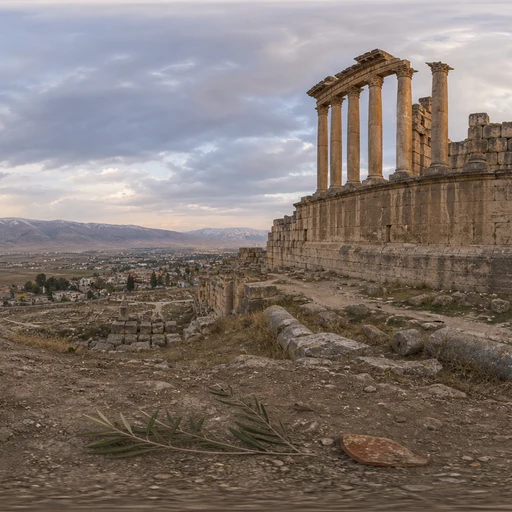
Ilyas at Baalbek
Time of Ilyas (peace be upon him)

The First Burial
Time of Adam (peace be upon him)

Cast Upon the Shore
Time of Yunus (peace be upon him)

The Table and the Disciples
The ministry of 'Isa (peace be upon him), Roman-period Galilee
Guess places like this in GeoSiyer
Drop into a 360° scene from Islamic history and pin where, and when, it happened.
Play GeoSiyer