Zengi Recovers Edessa
The first reconquest from the Crusaders, 539 AH
Jumada II 539 AH / 1144 CE
 Educational historical reconstruction
Where
Edessa (al-Ruha, modern Sanliurfa), upper Mesopotamia
37.1591, 38.7969 · View on OpenStreetMap
Background
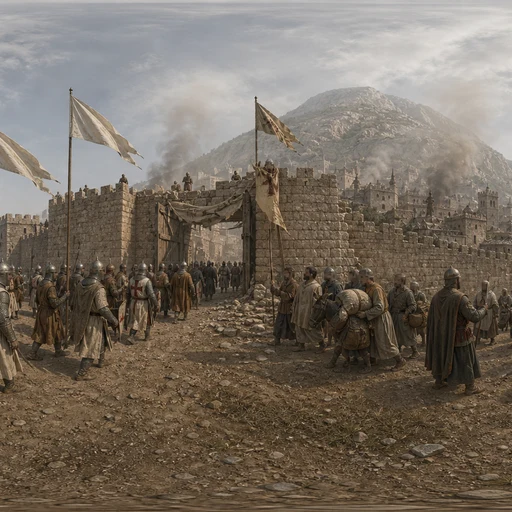
In Jumada II 539 AH (December 1144 CE) Imad al-Din Zengi, the Turkic atabeg of Mosul and Aleppo, captured the city of Edessa, called al-Ruha by the Muslims, from the Crusaders. Edessa was the seat of the County of Edessa, the first of the Crusader states to be founded after the First Crusade, an exposed Frankish principality in the upper Mesopotamian plain. Zengi besieged the city while its count was away, stormed it after the walls were breached, and so won back the first of the Latin states in the East, nearly half a century after the Crusaders had come. The recovery of Edessa is remembered as the opening victory of the Muslim counter-crusade, the gathering of the scattered Muslim response to the Frankish presence into a sustained movement of recovery and jihad. Zengi's work would be continued by his son Nur al-Din, who unified Muslim Syria, and then by Salah al-Din (Saladin), who would recover Jerusalem in 583 AH. The sources note that in taking the city Zengi struck at the Frankish garrison and rule rather than at the native Eastern Christians and Armenians of Edessa, whose churches and community were largely spared, a distinction the Muslim historians record with approval. The fall of Edessa shocked Latin Christendom and called forth the Second Crusade from Europe, which failed before Damascus, leaving the momentum with the Muslim side. The recapture is recorded by Ibn al-Athir, whose family served the Zengids, in his al-Kamil fi al-Tarikh and his dedicated dynastic history al-Tarikh al-Bahir fi al-Dawla al-Atabakiyya, by the Damascus chronicler Ibn al-Qalanisi in his Dhayl Tarikh Dimashq, and by the Syriac and Latin writers of the other side, Michael the Syrian and William of Tyre. This scene depicts the storming itself: a great square tower in the curtain wall broken open and collapsed into rubble, the host of the Turkic atabeg drawn up before the breach under its black and green banners, the townsfolk of the captured city gathered with a laden cart at the gap, and a native church standing intact behind the wall, the first turn of a tide that would run, in time, to Jerusalem.
What you see
A great square tower in the stone curtain wall has been broken open at its top, its masonry collapsed into a heap of rubble that spills through the gap. This is the breach the besiegers drove through, and the assault has just carried the wall.
Drawn up before the broken wall on one side is a body of horsemen and foot soldiers under tall banners, some black and some green, carrying round shields. These are the troops of a Turkic atabeg, the host that has just taken the place by storm.
The dark and green standards over the assaulting column are those of a Turkic atabeg of Mosul and Aleppo, the first of the great leaders of the Muslim counter-crusade, whose work his son and then a later sultan would carry on toward the recovery of Jerusalem.
On the far side of the gap a press of robed townsfolk gathers, with a laden ox-cart among them, the civilian life of a captured city in the hour of its fall. No bodies and no killing are shown; the moment is the entry, not a massacre.
Behind the crenellated wall a domed Eastern Christian church stands intact. The native Christians and Armenians of the city were largely spared; the storm fell on the Frankish garrison and its rule, a distinction the Muslim historians record with approval.
This is the first of the Crusader states to be recovered for Islam, the County of Edessa, the earliest Frankish principality founded in the East, taken back nearly half a century after the Crusaders came: the opening victory of the counter-crusade.
The fall of this city would strike Latin Christendom with alarm and call forth a new great crusade from Europe, making this storming a turning point in the long contest between Crusader and Muslim in Syria and the Jazira.
The dry, treeless ground and the long stone walls belong to a city of the open upper Mesopotamian plain, the Jazira, an inland town of the north associated in tradition with the Prophet Ibrahim (peace be upon him), not a port of the Levantine coast.
Primary sources
Ibn al-Athir, al-Kamil fi al-Tarikh and al-Tarikh al-Bahir fi al-Dawla al-Atabakiyya (early 13th c.): Sunni historical synthesis and a dedicated history of the Zengid atabegs of Mosul, by a historian whose family served the dynasty. The principal source for Zengi and the storming of Edessa, including the breach of the wall and the sparing of the native Christians; favourable to the Zengids but detailed. Confidence high.
Further reading & cross-references
Ibn al-Qalanisi, Dhayl Tarikh Dimashq (12th c.): Contemporary Damascus chronicle. Near-contemporary Sunni source for the Syrian and Jaziran wars of the period, including the fall of Edessa. Confidence high.
Abu Shama, Kitab al-Rawdatayn (13th c.): Sunni history of the reigns of Nur al-Din and Saladin, gathering earlier material. Used for the place of Edessa in the rise of the counter-crusade. Confidence high.
Michael the Syrian and William of Tyre (12th c., Syriac and Latin): Christian writers of the other side. Non-Muslim cross-references confirming the siege, the fall of the city, and the sparing of the native Christians. Used for date and place, not religious framing. Confidence high as witnesses.
Carole Hillenbrand, The Crusades: Islamic Perspectives (1999): Modern non-confessional academic study. Used for the meaning of Edessa in the Muslim counter-crusade and Zengi's place before Nur al-Din and Saladin. Confidence high.
Questions & answers
- Where is Zengi Recovers Edessa?
- Edessa (al-Ruha, modern Sanliurfa), upper Mesopotamia
- When did it happen?
- Jumada II 539 AH / 1144 CE
- What is the story of Zengi Recovers Edessa?
- In Jumada II 539 AH (December 1144 CE) Imad al-Din Zengi, the Turkic atabeg of Mosul and Aleppo, captured the city of Edessa, called al-Ruha by the Muslims, from the Crusaders. Edessa was the seat of the County of Edessa, the first of the Crusader states to be founded after the First Crusade, an…
Related places



Guess places like this in GeoSiyer
Drop into a 360° scene from Islamic history and pin where, and when, it happened.
Play GeoSiyer