Cairo Sabil Kuttab Charity
Water below and Qur'an lessons above in an endowed Cairo street
c. 1800 CE
 Educational historical reconstruction
Where
Cairo, Ottoman Egypt
30.0444, 31.2357 · View on OpenStreetMap
Background
The sabil kuttab was one of Cairo's most recognizable charitable building types. A sabil offered drinking water to passersby, while the kuttab above taught children Qur'an recitation, writing, and basic literacy. Around 1800, such buildings still made the old city readable as a landscape of waqf services. This scene focuses on a shaded street corner where water jars, cups, attendants, school windows, children, writing boards, carved stone, and wooden screens work together. The charity is simple, but its design is sophisticated. Water had to be stored, cooled, served, staffed, and funded. Teaching required a teacher, a room, materials, and regular support. A waqf could bind these needs to a building and make them part of daily urban life. The date is approximate because the scene represents a long-lived Cairo institution rather than one foundation ceremony. The lesson is that Muslim charitable architecture was not only monumental. It could meet ordinary needs in the street, where a thirsty worker, a child learning Qur'an, a water carrier, and a donor's endowment all belonged to the same city system.
What you see
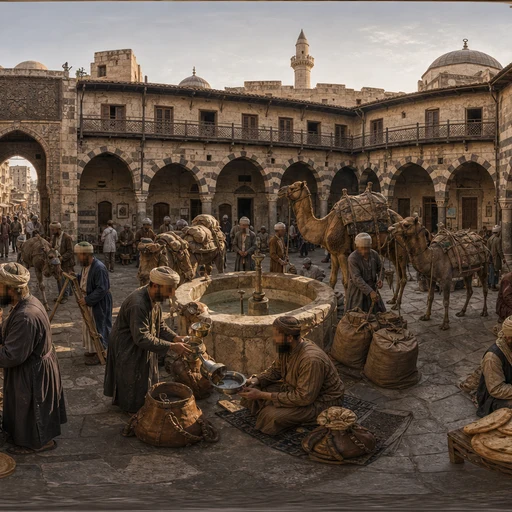
The carved stone facade, screened upper windows, and decorated street corner point to Islamic Cairo.
Water jars, cups, basins, and a serving attendant identify the lower level as a sabil.
Children and writing boards above the fountain suggest a kuttab for Qur'an learning.
Dense stone lanes, mashrabiya windows, and a minaret skyline make the place Egyptian rather than Ottoman Anatolian.
The scene presents everyday endowed service, not a political event or festival.
Water carriers and passersby show why a public drinking fountain mattered in a hot city.
The combined water school building joins bodily need, literacy, and piety in one waqf structure.
Further reading & cross-references
Doris Behrens-Abouseif, Islamic Architecture in Cairo: Used for sabil kuttab form, Cairo facade cues, and the urban role of endowed buildings.
André Raymond, Cairo: Used for Ottoman Cairo streets, quarters, water services, markets, and everyday urban structure.
Nasser Rabbat, The Citadel of Cairo: Used for Cairo architectural language, patronage, and the public face of Islamic urban buildings.
Adam Sabra, Poverty and Charity in Medieval Islam: Used for charity, poverty relief, and Cairo's broader tradition of endowed support.
Museum With No Frontiers, Islamic Art in the Mediterranean: Used for public-facing descriptions of sabils, kuttabs, and water architecture in Egypt.
Questions & answers
- Where is Cairo Sabil Kuttab Charity?
- Cairo, Ottoman Egypt
- When did it happen?
- c. 1800 CE
- What is the story of Cairo Sabil Kuttab Charity?
- The sabil kuttab was one of Cairo's most recognizable charitable building types. A sabil offered drinking water to passersby, while the kuttab above taught children Qur'an recitation, writing, and basic literacy. Around 1800, such buildings still made the old city readable as a landscape of waqf…
Related places




Guess places like this in GeoSiyer
Drop into a 360° scene from Islamic history and pin where, and when, it happened.
Play GeoSiyer