The Mustansiriyya Madrasa
The great Abbasid college on the Tigris, Baghdad, 1234 CE
631 AH / 1234 CE
 Educational historical reconstruction
Where
The Mustansiriyya, on the Tigris, Baghdad
33.3389, 44.3869 · View on OpenStreetMap
Background
The Mustansiriyya madrasa at Baghdad, completed in 631 AH (1234 CE), was founded by the Abbasid caliph al-Mustansir billah and was among the greatest institutions of learning of the medieval Muslim world. It was a purpose-built college on a grand scale: a great rectangular complex set around a vast open brick courtyard, with tall vaulted iwans opening on each side and ranges of small student cells in two storeys behind richly patterned brickwork, one long front rising directly from the bank of the Tigris that ran through the caliphal capital. It was famous as the first madrasa endowed to teach all four schools of Sunni law, the Hanafi, Maliki, Shafi'i and Hanbali, together under one roof, with stipends, lodging, food and medical care provided for the students and masters from its endowment (waqf), alongside teaching in the Qur'an, hadith, medicine and the other sciences. It held a large library and, by the report of the sources, an ingenious mechanical water-clock at its gate that marked the hours of prayer and study. The Mustansiriyya was raised in the last decades of Abbasid Baghdad, only about a generation before the Mongol armies under Hulagu sacked the city and ended the caliphate in 1258, so that it stands as a high point of Sunni learning and patronage on the very eve of that catastrophe; remarkably, the building itself survived the sack and still stands by the Tigris. This scene depicts the college in its days as a living institution: the great brick courtyard and its iwans, the student cells, the library and the water-clock, on the bank of the river in the heart of Baghdad. In keeping with the project's ethics any figures are kept anonymous and at a distance.
What you see
A great rectangular college built around a vast open brick courtyard, tall vaulted halls (iwans) opening on each side and ranges of small student cells in two storeys behind richly patterned brickwork; a purpose-built madrasa on a grand scale.
One long side of the college rises directly from the bank of a broad river running through a great city; this is the Tigris at Baghdad, the seat of the caliphate.
Within are a large library and lecture halls, and by report an ingenious water-clock at the gate marking the hours of prayer and study; a place built for learning, not for war or worship alone.
The Mustansiriyya was founded by the Abbasid caliph al-Mustansir and was among the greatest colleges of the medieval Muslim world, the first to teach all four Sunni schools of law together under one roof, with stipends and lodging for students and masters.
It was completed in the last decades of Abbasid Baghdad, only a generation before the Mongol sack of 1258; a high point of Sunni learning on the very eve of catastrophe.
The Mustansiriyya was completed in 631 AH (1234 CE) under al-Mustansir billah; its plan, library and water-clock are described by the medieval sources. The building still stands by the Tigris.
Primary sources
Histories of late Abbasid Baghdad (Ibn al-Athir and others): Used for the setting in the last decades of the caliphate before the Mongol sack of 1258.
Further reading & cross-references
Medieval accounts of the Mustansiriyya (its foundation, the four-madhhab teaching, the library and water-clock): Used for the founding under al-Mustansir, the four schools taught together, the endowment, the library and the water-clock.
Studies of the madrasa as an institution (academic): Used for the place of the Mustansiriyya in the history of Islamic colleges and the waqf system. Non-confessional cross-reference.
The standing Mustansiriyya building (extant, material): The surviving college on the Tigris, its courtyard, iwans and brickwork constrain the depiction; it survived the 1258 sack.
Questions & answers
- Where is The Mustansiriyya Madrasa?
- The Mustansiriyya, on the Tigris, Baghdad
- When did it happen?
- 631 AH / 1234 CE
- What is the story of The Mustansiriyya Madrasa?
- The Mustansiriyya madrasa at Baghdad, completed in 631 AH (1234 CE), was founded by the Abbasid caliph al-Mustansir billah and was among the greatest institutions of learning of the medieval Muslim world. It was a purpose-built college on a grand scale: a great rectangular complex set around a vast…
Related places

Tigris Shore After the Sack of Baghdad
656 AH / 1258 CE

The Mihna and the Stand of Imam Ahmad
The Mihna (218-234 AH / 833-848 CE)

The House of Wisdom
c. 215 AH / 830 CE
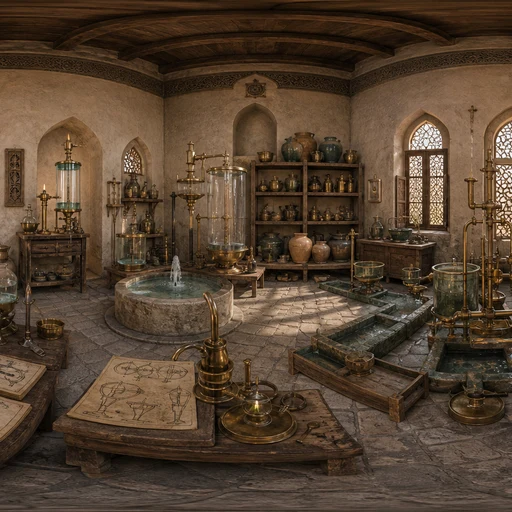
The Banu Musa and the Ingenious Devices
c. 236 AH / 850 CE
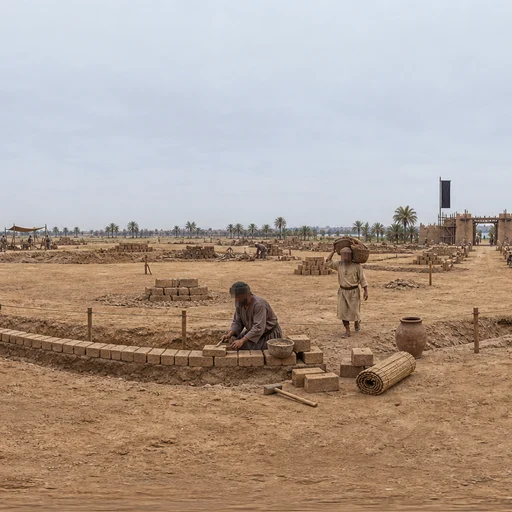
The Founding of the Round City of Baghdad
145 AH / 762 CE

The Fall of Ctesiphon
16-21 AH / 637-642 CE
Guess places like this in GeoSiyer
Drop into a 360° scene from Islamic history and pin where, and when, it happened.
Play GeoSiyer