The Malwiya at Samarra
The Great Mosque of Samarra under Caliph al-Mutawakkil, 241 AH
241 AH / 855-856 CE
 Educational historical reconstruction
Where
Samarra (Surra Man Ra'a), Abbasid capital on the Tigris
34.2050, 43.8794 · View on OpenStreetMap
Background
The Great Mosque of Samarra, al-Jami' al-Kabir bi-Samarra, was commissioned by the Abbasid Caliph al-Mutawakkil 'ala Allah (rahimahu Allah) in 234 AH (848-849 CE) and completed around 241 AH (855-856 CE). The mosque was the largest in the Islamic world at the time of its construction and one of the largest ever built: an outer enclosure of fired brick measuring approximately 240 by 156 metres, articulated with semi-circular bastion-towers, enclosing a sahn and a vast hypostyle prayer hall supported on hundreds of brick piers. To the north of the precinct, on a separate platform connected by a stone causeway, stands the Malwiya (the 'snail-shell'), a helical minaret of fired brick rising 52 metres in five turns of a continuous external ramp to a small cylindrical summit, a form without precedent in the prior mosque tradition and an Abbasid invention of monumental brick. The mosque served the new Abbasid capital of Surra Man Ra'a (Samarra), founded on the east bank of the Tigris by the Caliph al-Mu'tasim (rahimahu Allah) in 221 AH (836 CE) to house the new Turkic and Khurasani regiments of the Abbasid army and to relieve the pressure on Baghdad; the city served as Abbasid capital from 221 AH until 279 AH (892 CE) when al-Mu'tamid returned the seat to Baghdad. The Sunni historical sources (al-Tabari, al-Mas'udi, Ibn Kathir) record the Caliph al-Mutawakkil (rahimahu Allah) as the patron who restored Sunni Islam to its place at the centre of the Abbasid state after the mihna, the trial over the createdness of the Qur'an instituted by his predecessors al-Ma'mun and al-Mu'tasim, in which Imam Ahmad ibn Hanbal (rahimahu Allah) and the Sunni traditionists of Baghdad were imprisoned and flogged for their refusal to assent to the Mu'tazili doctrine; the Caliph al-Mutawakkil (rahimahu Allah) ended the mihna, returned patronage to the Ahl al-Hadith, and is remembered in Sunni tradition as al-Muhyi li'l-Sunna, the reviver of the Sunna. The Great Mosque of Samarra is the public monument of that Sunni restoration. The mosque was partially destroyed by the Mongols in 656 AH (1258 CE); the prayer hall and the precinct walls survive only as ruins, but the Malwiya minaret survives substantially intact and remains the iconic monument of Samarra. The minaret was damaged by an explosion in 1426 AH (2005 CE) but stands; the city of Samarra is on the UNESCO World Heritage List. This scene depicts the mosque at the late stage of its construction in 241 AH, with the Malwiya complete and the final brickwork of the precinct walls under way.
What you see
A vast new city laid out on the east bank of a great river on a flat alluvial plain in northern Mesopotamia. The river, the Tigris, is broad and green; the city stretches northward along its bank for many farsakhs in a planned ribbon of palaces, residential quarters, and cantonments. There is no older city beneath: this is a city of the Caliph's command, founded barely twenty years earlier.
At the centre of the scene, an enormous rectangular precinct of fired brick rises from the plain, the largest mosque ever built in the Islamic world to its date, and one of the largest of all time. The outer walls are an unbroken expanse of dressed brick, articulated with semi-circular bastion-towers at regular intervals, enclosing an inner sahn and a vast hypostyle prayer hall on hundreds of brick piers.
To the north of the precinct, set on its own platform connected to the mosque by a stone causeway, rises a spiral minaret of unprecedented form, the Malwiya, the 'snail-shell', a great helical brick tower, 52 metres tall, with a continuous external ramp winding five times around it to the summit. The form has no precedent in the prior Sunni mosque tradition; it is an Abbasid invention of monumental brick.
The city is Surra Man Ra'a, 'He Who Sees It is Delighted', the new Abbasid capital founded by the Caliph al-Mu'tasim (rahimahu Allah) in 221 AH (836 CE) to house the Turkic and Khurasani regiments. The Caliph al-Mutawakkil 'ala Allah (rahimahu Allah), eighth Abbasid caliph, has now commissioned in 234 AH (848-849 CE) the great congregational mosque to serve the city; the work is nearing completion in 241 AH (855-856 CE), the date preserved by Sunni historical tradition.
Below the great helix, brick masons and labourers organise the final courses of the precinct wall; carts bring bricks from the kilns on the river bank; foremen in plain Abbasid dress consult plans on parchment. The workforce is the disciplined imperial workforce of the Abbasid caliphate at the height of its institutional reach.
The scale is the public sign of the Abbasid caliphate as the patron of Sunni Islam at the height of its imperial reach. The Caliph al-Mutawakkil (rahimahu Allah) is the Abbasid caliph remembered in the Sunni tradition for restoring the Sunni position after the mihna, the trial over the createdness of the Qur'an, and for returning patronage to the Ahl al-Hadith of Baghdad, the Sunni traditionists led by Imam Ahmad ibn Hanbal (rahimahu Allah). The great mosque is the public monument of that Sunni restoration.
The light is the high silver light of central Mesopotamia in spring. The horizon is flat in every direction except along the river, where date palms and irrigated gardens give a thin green band. The Malwiya is the highest structure for a hundred miles.
The construction of the Great Mosque of Samarra and its Malwiya minaret is preserved in the Sunni historical tradition (al-Tabari's Tarikh, al-Ya'qubi's Kitab al-Buldan, used here for topographical detail only, al-Mas'udi, Ibn Kathir). The construction date 234-241 AH and the patron are firm; the architectural form is preserved in the standing fabric of the Malwiya itself.
Primary sources
al-Tabari, Tarikh al-Rusul wa-al-Muluk (early 10th c.): The principal early Sunni historical narrative. al-Tabari was himself a resident of Baghdad in the years following the Samarra period and the dating of the Caliph al-Mutawakkil's (rahimahu Allah) commissioning of the mosque (234 AH) and the political context of the Sunni restoration after the mihna is preserved in his Tarikh.
Ibn Kathir, al-Bidaya wa al-Nihaya (14th c.): Standard Sunni history. Synthesises the construction with the broader account of the reign of al-Mutawakkil (rahimahu Allah), his ending of the mihna, and his patronage of the Ahl al-Hadith.
Ibn al-Athir, al-Kamil fi al-Tarikh (early 13th c.): Sunni historical synthesis. Used for the broader Abbasid chronology and the Samarra period.
al-Dhahabi, Tarikh al-Islam (14th c.): Major Sunni historian and hadith critic. The biographical entry on al-Mutawakkil (rahimahu Allah) preserves the Sunni reverence for him as the reviver of the Sunna and the ender of the mihna.
Further reading & cross-references
The Malwiya minaret (extant): The minaret survives substantially intact in its 241 AH form, despite damage by explosion in 2005 CE. The most authoritative material witness to the construction. The architectural form depicted in the scene is reconstructive against the standing fabric.
al-Mas'udi, Muruj al-Dhahab wa-Ma'adin al-Jawhar (mid-10th c.): Major historian and geographer. Sunni in his formal madhhab (Shafi'i); used here for topographical detail and the broader account of the Caliph al-Mutawakkil's (rahimahu Allah) reign and the Samarra capital.
K.A.C. Creswell, Early Muslim Architecture (Penguin, 1932/1958): Standard architectural reference. Provides the precise dimensions, structural system, materials, and dating of the mosque and the Malwiya. Used purely as an architectural-historical reference.
Alastair Northedge, The Historical Topography of Samarra (BISI/SAS, 2005-2007, 2 vols): Major modern archaeological survey of Samarra. Used for the precise reconstruction of the city plan and the position of the Great Mosque within it.
Questions & answers
- Where is The Malwiya at Samarra?
- Samarra (Surra Man Ra'a), Abbasid capital on the Tigris
- When did it happen?
- 241 AH / 855-856 CE
- What is the story of The Malwiya at Samarra?
- The Great Mosque of Samarra, al-Jami' al-Kabir bi-Samarra, was commissioned by the Abbasid Caliph al-Mutawakkil 'ala Allah (rahimahu Allah) in 234 AH (848-849 CE) and completed around 241 AH (855-856 CE). The mosque was the largest in the Islamic world at the time of its construction and one of the…
Related places
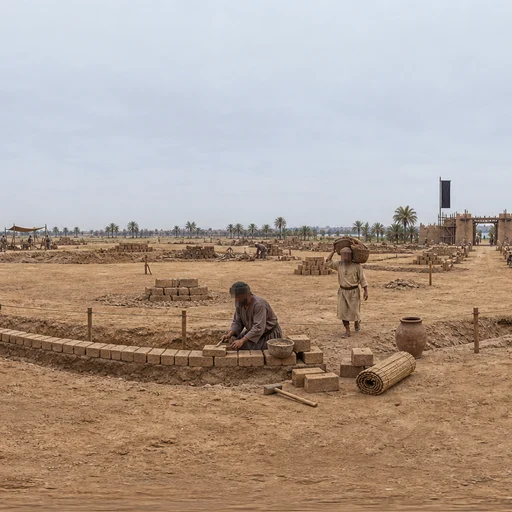
The Founding of the Round City of Baghdad
145 AH / 762 CE

Tigris Shore After the Sack of Baghdad
656 AH / 1258 CE

The Mustansiriyya Madrasa
631 AH / 1234 CE

The Mihna and the Stand of Imam Ahmad
The Mihna (218-234 AH / 833-848 CE)

The House of Wisdom
c. 215 AH / 830 CE
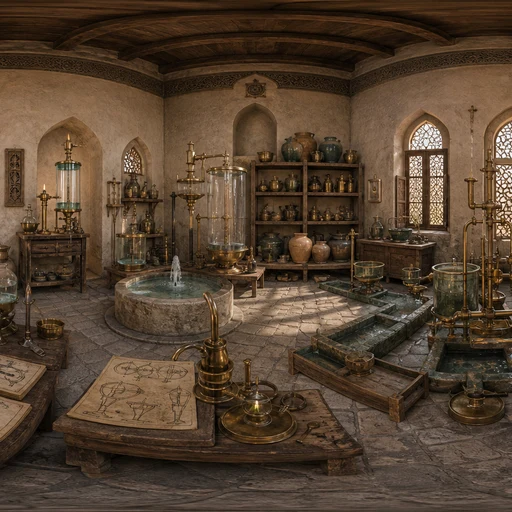
The Banu Musa and the Ingenious Devices
c. 236 AH / 850 CE
Guess places like this in GeoSiyer
Drop into a 360° scene from Islamic history and pin where, and when, it happened.
Play GeoSiyer